
Cups · Minor Arcana
Five of Cups
Grief, regret, focus on loss over what remains
Go deeper with Five of Cups
The meanings below are a starting point. Bring what's actually on your mind and reflect on it here — what comes back is a question to sit with, never a forecast.
Reflection Room
Five of Cups · upright
Write and save if you'd rather sit with it alone. Nothing is sent.
Five of Cups Upright Meaning
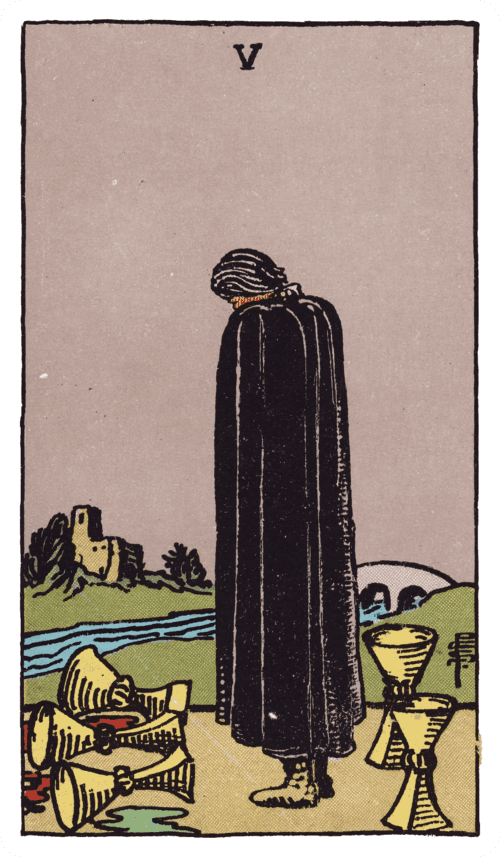
The Five of Cups is the card of standing in the aftermath — after the argument, the ending, the disappointment — and being unable to look away from what spilled. Three cups have fallen; two still stand behind the figure. The card doesn't dismiss the loss as small. It asks whether you've noticed yet what didn't fall.
This card as a mirror: what loss or disappointment has your attention right now — and what is still standing behind you that you haven't fully turned to face?
Five of Cups Reversed Meaning
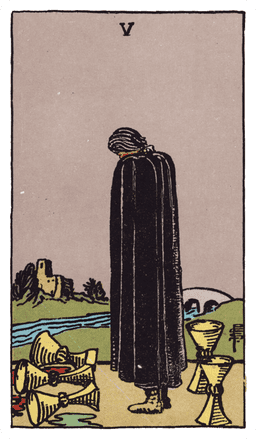
The Five of Cups reversed often signals a turning point — the moment when you finally look over your shoulder and see the two standing cups. It doesn't mean the grief is gone, but something has shifted. You're beginning to consider that what remains might be enough, or at least worth tending. Recovery isn't linear, but this card suggests the direction has changed.
What might be shifting in how you're holding a loss or difficulty — and what would it feel like to let your attention move, even slightly, toward what hasn't been taken?
The Five of Cups in Love & Relationships
Upright
You're in the space where you can see what broke clearly — whether it's trust, a specific argument, or the relationship's shape shifting. This card asks: are you cataloging only the damage, or have you noticed what's still there in the relationship (or in yourself)? Grief about connection is real; the question is whether you're looking at the whole picture.
Reversed
Something is loosening in how you're holding the hurt — not because it's gone, but because you're starting to see past it. You might be noticing a partner's effort you'd overlooked, or realizing a friendship or connection has survived what you thought would break it. The shift is internal first; the relationship follows.
The Five of Cups in Work & Career
Upright
A project failed, you didn't get the role, the team fell apart — and you're standing in the debris of it. The card doesn't minimize the loss; it asks whether the disappointment has your full attention, or whether you've also noticed what's still functioning: your skills, your reputation elsewhere, the colleagues who stayed. What's the actual scope of what fell versus what you're treating as total collapse?
Reversed
You're beginning to see the work or role differently after the setback. Maybe you're noticing skills you built during the difficult period, or realizing the failure closed a door that was never the right one anyway. Recovery here looks like redirecting effort toward what's still standing — the parts of your work that still matter to you, the people or projects worth tending.
Five of Cups: Yes or No?
Leans toward no — and the better question underneath is: what are you measuring against, and does that measure reflect what's actually still available to you?
Yes-or-no readings are the one place tarot pretends to be a fortune teller. We answer the question, then hand you the better one underneath it — that's the part worth your time.
Questions to ask when you draw Five of Cups
- What specifically hasn't fallen that you've been avoiding looking at?
- Are you treating this loss as final because of what happened, or because grief has narrowed your view of what's possible next?
- If you couldn't change the thing that fell, what would become possible if you tended to what remains instead?
Guides that talk about Five of Cups
Cards near Five of Cups
Next door in Cups
The other Fives
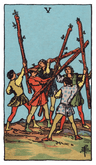
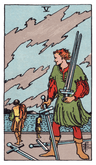
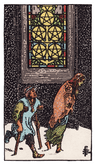
Shares its themes
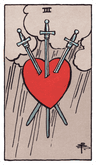
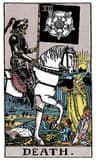
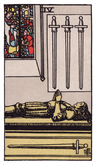
Five of Cups Symbolism
Interpretive Traditions
Different schools of tarot bring different lenses to the Five of Cups. These are perspectives, not contradictions.
Rider-Waite-Smith
Waite's description focused on the figure in mourning over spilled wine, but emphasised that the standing cups offer what is not yet lost. He framed the card as a caution against 'vain regret' — not that grief is wrong, but that it can blind us to what still stands. The bridge in the background was deliberate: there is always a way across.
Thoth
Crowley titled this card 'Disappointment' and associated it with Mars in Scorpio — a particularly intense combination of action and depth, frustration and emotional intensity. In the Thoth system the Five of Cups carries the sense of pleasure disrupted, of an expectation that met reality and lost. It's less about grief and more about the specific sting of things not going as hoped.
Modern Intuitive
Contemporary readers often use this card as an entry point for talking about the difference between grieving and being stuck. The loss is real — that's never in question — but the two standing cups have become a kind of cultural shorthand for asking: what are you not letting yourself see right now? The card is compassionate about the difficulty of that question.
Five of Cups Keywords & Themes
The Five of Cups tarot card is associated with the following themes and keywords across upright and reversed positions: grief, regret, fixation on loss, what remains, emotional aftermath, recovery, acceptance, beginning to move on, finding what remains. Its elemental correspondence is Water. Astrologically it is linked to Scorpio. Its planetary ruler is Mars.
Whether you drew the Five of Cups in a daily pull, a weekly spread, or a year-ahead reading, its core invitation is the same: to look honestly at what this card is reflecting in your own life. Tarot Digest uses the Five of Cups — and all 78 cards — as mirrors for self-inquiry, not prediction.
Recommended Decks & Books
Whether you're just starting with tarot or deepening a long practice, these are the decks and books most worth your time.
- 🃏
The Original Rider Waite Smith Tarot — A.E. Waite & Pamela Coleman Smith
The deck that defined modern tarot. First published in 1909, the RWS introduced illustrated pip cards for all 78 positions — a breakthrough that made tarot accessible to everyone. Every major deck since is either an homage or a reaction to it.
- 📖
Seventy-Eight Degrees of Wisdom — Rachel Pollack
The definitive companion to tarot, first published in 1980 and still the best single-volume guide. Pollack reads the cards as a living psychological system — the Major Arcana as a map of consciousness, the Minor as the terrain of daily life.
- 📖
The Creative Tarot — Jessa Crispin
A guide to using tarot as a tool for creative practice rather than divination — written for writers, artists, and makers. Crispin brings a sharp literary sensibility and treats the cards as a language for thinking about creative process.
- 🃏
Modern Witch Tarot Deck — Lisa Sterle
The RWS structure reimagined with diverse, contemporary figures in modern settings. Every symbol from the original is preserved (the Fool still stands at the cliff edge, the High Priestess still flanked by pillars), but the world looks like ours.
Links above may earn a small commission at no cost to you — affiliate code tarotdigest-20. Disclosure