
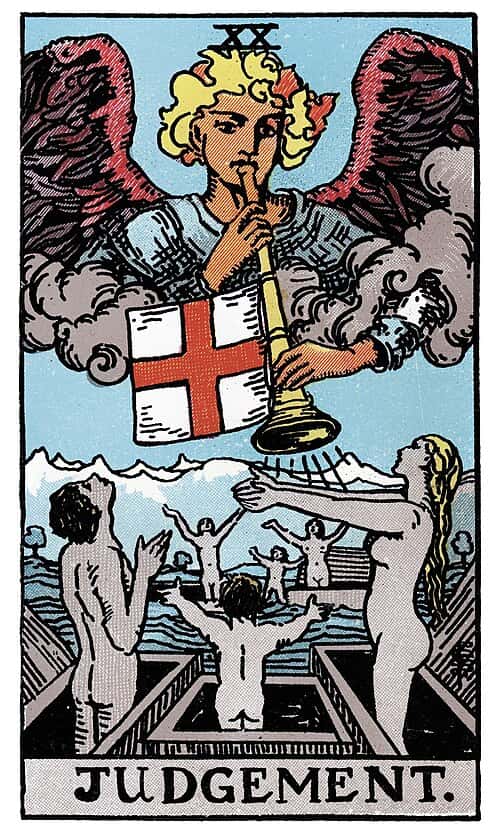
XX · Major Arcana
Judgement
Awakening, calling, transformation, reckoning, clarity
Also known as
Thoth: The Aeon — Crowley replaced the Christian resurrection imagery with 'The Aeon' — the dawning of a new age of consciousness. The underlying theme of answering a genuine call and rising to meet a new chapter is shared; the cosmological framework is very different.
Some modern decks: Judgment (alternate spelling) — Both 'Judgement' (British) and 'Judgment' (American) spellings are used depending on the deck's origin. Same card.
Go deeper with Judgement
The meanings below are a starting point. Bring what's actually on your mind and reflect on it here — what comes back is a question to sit with, never a forecast.
Reflection Room
Judgement · upright
Write and save if you'd rather sit with it alone. Nothing is sent.
Judgement Upright Meaning
This card invites you to hear and respond to what is calling you — not the voice of obligation or external expectation, but something that feels like an authentic summons from within. Judgement appears when you've integrated enough of your own journey to know what you actually care about, and when something is asking you to claim that knowledge and act from it. It can also represent a moment of genuine reckoning, a clear seeing of where you actually stand.
This card as a mirror: what is calling you right now — not an obligation or expectation, but something that feels like a summons? What would it mean to answer it honestly?
Judgement Reversed Meaning
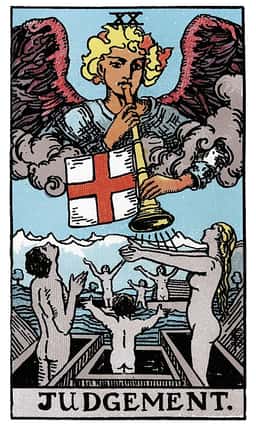
Judgement reversed can signal a moment when you're not yet hearing the call clearly — or you're hearing it but doubting whether you have the right to answer. You might be postponing a reckoning that needs to happen, or caught in self-doubt about your own capacity. Sometimes this card suggests that the call has come but you're not yet ready to respond, and that's information too.
This card as a mirror: what call are you not quite hearing — or what call are you hearing but afraid to answer?
The Judgement in Love & Relationships
Upright
Judgement asks you to notice what you actually want from this relationship, separate from what you think you should want. This card appears when you're ready to stop performing and start speaking from what you've learned about yourself. The question isn't whether this person is right for you in theory — it's whether answering the call to be honest with them feels possible.
Reversed
You might be hearing something important about this relationship but unsure whether you're allowed to name it. Doubt can look like loyalty, and postponement can feel safer than a reckoning. This card suggests the call is there; you're just not yet certain you have the standing to answer it.
The Judgement in Work & Career
Upright
Something in your work is asking for your real attention and commitment, not just your time. Judgement appears when you've done enough to know what actually matters to you professionally, and when that knowledge is demanding a response. The card invites you to notice the difference between a job that fits and a call that pulls.
Reversed
You might sense what you need to do or change, but doubt is keeping you from acting. Perhaps you're waiting for permission, or wondering if you're ready, or caught between what you think you should do and what's actually calling you. The reversal suggests the clarity exists — the hesitation is the real thing to examine.
Judgement: Yes or No?
Leans toward yes — and the better question underneath is: am I ready to act on what I already know about this?
Yes-or-no readings are the one place tarot pretends to be a fortune teller. We answer the question, then hand you the better one underneath it — that's the part worth your time.
Questions to ask when you draw Judgement
- What is asking for your attention right now that you've been avoiding or second-guessing?
- If you set aside what you think you should do, what do you actually care about here?
- What would change if you believed you had the authority to answer this call?
Guides that talk about Judgement
Cards near Judgement
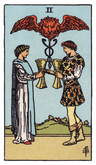
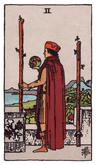
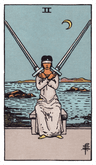
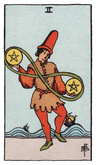
Shares its number: the Twos
Judgement Symbolism
Interpretive Traditions
Different schools of tarot bring different lenses to the Judgement. These are perspectives, not contradictions.
Rider-Waite-Smith
Waite grounded Judgement not in divine judgment but in the human capacity for authentic choice and response. The card represents the moment when you hear your own deepest calling and choose to answer it. This is a card of freedom and responsibility, not punishment.
Thoth
Crowley's Judgement represents rebirth and the transformation of consciousness — moving from one level of being to another. The card emphasises the distinction between unconscious reaction and conscious response, between being a victim of circumstances and actively engaging in your own becoming.
Modern Intuitive
Contemporary readers often frame Judgement as a card of permission and clarity — permission to hear your own voice, permission to say yes to what matters to you. Many modern interpreters see it as the moment when everything you've learned coalesces into knowing what you actually want to do with your life.
Campbell parallel
The Return — the crossing of the return threshold
In your life
Judgement appears when something genuine is calling you forward — not an obligation or expectation, but something that feels like a summons from your own deepest self. It is the moment when you've moved through the journey enough to hear what you're actually being called toward, and the question becomes: will you answer?
Judgement Keywords & Themes
The Judgement tarot card is associated with the following themes and keywords across upright and reversed positions: awakening, responding to a call, integration, clarity of purpose, rebirth, reckoning, doubt, avoiding a call, postponing reckoning, self-questioning, unreadiness, muffled clarity. Its elemental correspondence is Fire. Its planetary ruler is Pluto.
Whether you drew the Judgement in a daily pull, a weekly spread, or a year-ahead reading, its core invitation is the same: to look honestly at what this card is reflecting in your own life. Tarot Digest uses the Judgement — and all 78 cards — as mirrors for self-inquiry, not prediction.
Recommended Decks & Books
Whether you're just starting with tarot or deepening a long practice, these are the decks and books most worth your time.
- 🃏
The Original Rider Waite Smith Tarot — A.E. Waite & Pamela Coleman Smith
The deck that defined modern tarot. First published in 1909, the RWS introduced illustrated pip cards for all 78 positions — a breakthrough that made tarot accessible to everyone. Every major deck since is either an homage or a reaction to it.
- 📖
Seventy-Eight Degrees of Wisdom — Rachel Pollack
The definitive companion to tarot, first published in 1980 and still the best single-volume guide. Pollack reads the cards as a living psychological system — the Major Arcana as a map of consciousness, the Minor as the terrain of daily life.
- 📖
The Creative Tarot — Jessa Crispin
A guide to using tarot as a tool for creative practice rather than divination — written for writers, artists, and makers. Crispin brings a sharp literary sensibility and treats the cards as a language for thinking about creative process.
- 🃏
Modern Witch Tarot Deck — Lisa Sterle
The RWS structure reimagined with diverse, contemporary figures in modern settings. Every symbol from the original is preserved (the Fool still stands at the cliff edge, the High Priestess still flanked by pillars), but the world looks like ours.
Links above may earn a small commission at no cost to you — affiliate code tarotdigest-20. Disclosure