
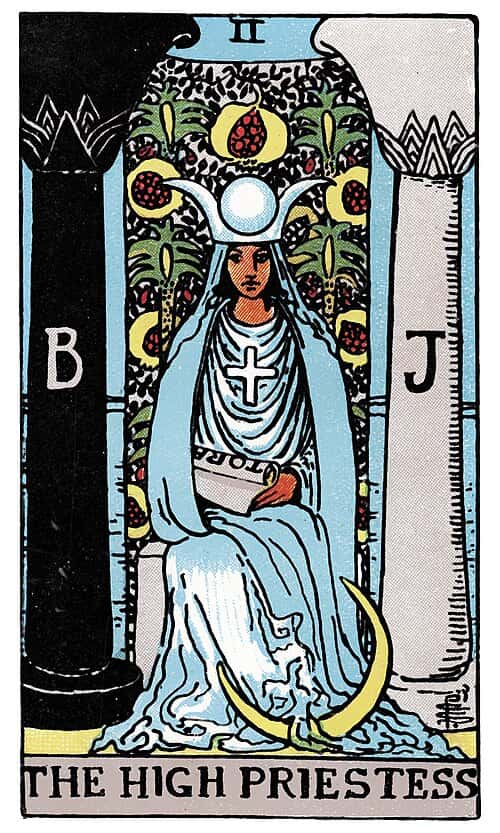
II · Major Arcana
The High Priestess
Intuition, inner wisdom, stillness, hidden knowledge
Also known as
Thoth: The Priestess — Crowley shortened the name to 'The Priestess', stripping away the institutional title and emphasising the pure archetype of inner knowing and mystery.
Marseille / Historical: The Papess — The original name in older European decks — literally 'the female pope.' Waite renamed the card to remove the specifically Catholic reference. Some feminist tarot traditions have reclaimed the Papess name.
Go deeper with The High Priestess
The meanings below are a starting point. Bring what's actually on your mind and reflect on it here — what comes back is a question to sit with, never a forecast.
Reflection Room
The High Priestess · upright
Write and save if you'd rather sit with it alone. Nothing is sent.
The High Priestess Upright Meaning
The High Priestess invites you to stop trying to solve and start listening. There is knowledge available to you right now that comes not from logic but from the quiet observation of what wants to be known. This card isn't about mystical secrets — it's about the intelligence of your own body, your own unconscious, your own deep seeing. What emerges when you stop forcing and start receiving?
This card as a mirror: what do you already know about this situation that you haven't yet let yourself trust — and what would it take to listen to that knowing?
The High Priestess Reversed Meaning
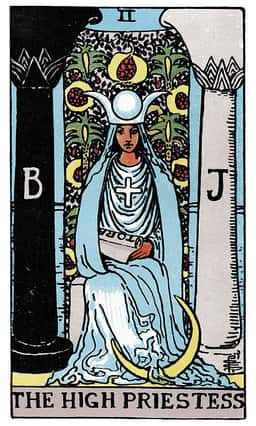
The High Priestess reversed often points to disconnection from inner knowing — either you're not listening, or the channel is blocked. You might be caught in overthinking, or perhaps someone else's secrets are clouding your own clarity. Sometimes this reversal surfaces something deeper: a knowing you've been refusing to acknowledge because the truth is inconvenient or frightening.
This card as a mirror: where are you overriding your own knowing — and what truth might you be avoiding?
The High Priestess in Love & Relationships
Upright
This card asks what you already sense about your relationship that you haven't trusted yet. The work here is noticing: the small hesitations, the body's signals, what emerges in quiet moments rather than in arguments or analysis. What would change if you let yourself believe what you already know?
Reversed
You might be talking yourself out of something you feel, or listening so hard to someone else's version of the relationship that you've lost track of your own reading. The block here is often not a lack of knowing but a reluctance to act on what you know. What truth about this relationship have you been too afraid to name?
The High Priestess in Work & Career
Upright
Pay attention to the quiet signals: your instincts about a person or decision, the information that arrives outside formal channels, what your body tells you about a situation before your mind catches up. This card suggests you have access to something useful right now that logic alone won't give you. Where in your work do you have a hunch you haven't yet trusted?
Reversed
You may be caught in overthinking, or someone else's agenda is clouding what you actually know about your role or next move. Sometimes this reversal points to knowing exactly what needs to happen but talking yourself out of it. What do you know about your work situation that feels too difficult or inconvenient to act on?
The High Priestess: Yes or No?
Leans toward yes — and the better question underneath is: what are you already sensing that would answer this for you, if you trusted it?
Yes-or-no readings are the one place tarot pretends to be a fortune teller. We answer the question, then hand you the better one underneath it — that's the part worth your time.
Questions to ask when you draw The High Priestess
- What has your body been telling you about this situation that your thinking mind keeps overriding?
- What do you know to be true here that would require you to change something if you fully acknowledged it?
- If you stopped trying to figure this out and just listened instead, what would you notice first?
Guides that talk about The High Priestess
Cards near The High Priestess
Beside it on the Fool's Journey
Shares its number: the Twos
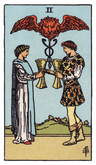
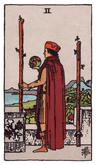
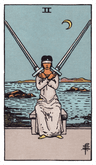
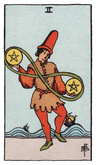
Shares its themes
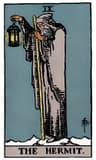
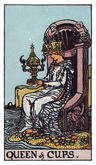
The High Priestess Symbolism
Interpretive Traditions
Different schools of tarot bring different lenses to The High Priestess. These are perspectives, not contradictions.
Rider-Waite-Smith
Waite positioned the High Priestess as the guardian of the veil between visible and invisible worlds. She is not supernatural — she is supremely natural in her attunement to the non-rational dimensions of reality. Her knowledge comes through receptivity and contemplative attention.
Thoth
In Crowley's system, the High Priestess represents pure receptivity, the unmanifest potential, the Great Mother as she exists before creation. Lady Frieda Harris's rendering emphasises transcendence and mystery; this priestess is closer to the divine than to the human.
Modern Intuitive
Contemporary readers often frame the High Priestess as validation of non-rational knowing — trusting gut feelings, dreams, synchronicity, body wisdom. She's the card that says your intuition is not flakiness; it's a different form of intelligence.
Campbell parallel
The Belly of the Whale (the first encounter with mystery)
In your life
The High Priestess appears when the answer you're seeking isn't available through thinking or effort — when something wants to emerge, but only in quietness. She asks: what do you already know that you've been talking yourself out of knowing?
The High Priestess Keywords & Themes
The High Priestess tarot card is associated with the following themes and keywords across upright and reversed positions: intuition, inner wisdom, receptivity, mystery, stillness, listening, disconnection, denial, overthinking, secrets, blocked intuition. Its elemental correspondence is Water. Its planetary ruler is Moon.
Whether you drew The High Priestess in a daily pull, a weekly spread, or a year-ahead reading, its core invitation is the same: to look honestly at what this card is reflecting in your own life. Tarot Digest uses The High Priestess — and all 78 cards — as mirrors for self-inquiry, not prediction.
Recommended Decks & Books
Whether you're just starting with tarot or deepening a long practice, these are the decks and books most worth your time.
- 🃏
The Original Rider Waite Smith Tarot — A.E. Waite & Pamela Coleman Smith
The deck that defined modern tarot. First published in 1909, the RWS introduced illustrated pip cards for all 78 positions — a breakthrough that made tarot accessible to everyone. Every major deck since is either an homage or a reaction to it.
- 📖
Seventy-Eight Degrees of Wisdom — Rachel Pollack
The definitive companion to tarot, first published in 1980 and still the best single-volume guide. Pollack reads the cards as a living psychological system — the Major Arcana as a map of consciousness, the Minor as the terrain of daily life.
- 📖
The Creative Tarot — Jessa Crispin
A guide to using tarot as a tool for creative practice rather than divination — written for writers, artists, and makers. Crispin brings a sharp literary sensibility and treats the cards as a language for thinking about creative process.
- 🃏
Modern Witch Tarot Deck — Lisa Sterle
The RWS structure reimagined with diverse, contemporary figures in modern settings. Every symbol from the original is preserved (the Fool still stands at the cliff edge, the High Priestess still flanked by pillars), but the world looks like ours.
Links above may earn a small commission at no cost to you — affiliate code tarotdigest-20. Disclosure