
Pentacles · Minor Arcana
Four of Pentacles
Security and stability, holding what you have, consolidation
Go deeper with Four of Pentacles
The meanings below are a starting point. Bring what's actually on your mind and reflect on it here — what comes back is a question to sit with, never a forecast.
Reflection Room
Four of Pentacles · upright
Write and save if you'd rather sit with it alone. Nothing is sent.
Four of Pentacles Upright Meaning
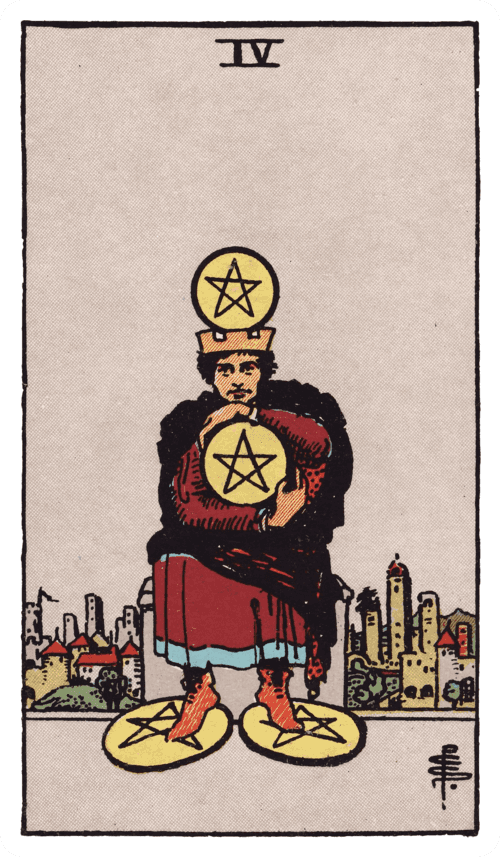
The Four of Pentacles is the card of having something solid and not wanting to let it go. In the RWS deck, a figure holds pentacles close, surrounded by a secure, walled space. This might be financial security, a stable job, a secure home, or a stable foundation in any area of life. The card speaks to the satisfaction and the anxiety of stability: the relief of knowing you have enough, and sometimes the rigidity that comes from fear of losing it. The Four asks: is what you're holding truly nourishing, or have you been holding so tightly that life can't move through anymore?
This card invites you to notice: what do you feel you need to hold tightly to feel safe — and what might become possible if you held just slightly more loosely?
Four of Pentacles Reversed Meaning
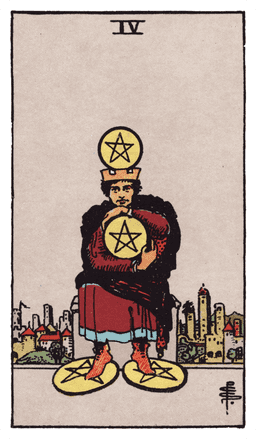
The Four reversed can signal that security has become stagnation — that holding on has become so tight nothing can breathe or grow. It might point to scarcity thinking that won't let you spend or share, even when you have enough. It can also reverse into the other direction: loss of security, money slipping away, the fear you were holding at bay suddenly becoming real. Sometimes this card reversed signals that what felt stable was actually false security — and the illusion is finally cracking. The invitation here is to examine what's actually happened and what's actually true about your security right now.
This card asks: where have you stopped the flow because you were afraid — and what would become possible if you could trust the flow a little more?
The Four of Pentacles in Love & Relationships
Upright
You might be noticing how much you've built with someone, and how carefully you're tending to that stability. The question worth sitting with: are you protecting the relationship itself, or are you protecting against the fear of losing it? There's a difference between commitment and grip.
Reversed
Something that felt solid may have become rigid, or you're holding back vulnerability because you're afraid of what might slip away. Pay attention to whether you've stopped sharing parts of yourself, or whether you're sensing that the security you thought you had was built on shakier ground than you believed.
The Four of Pentacles in Work & Career
Upright
You have something steady here: a job, a role, a position you've earned. Notice what you're afraid of losing, and whether that fear is keeping you from exploring a next step or asking for something more. Security and stagnation can look identical from the inside.
Reversed
Either the stability you were holding onto is actually coming loose, or you've been so focused on keeping things the same that you've missed signals that something needed to change. This card asks you to get honest about what's real: is your job secure, or have you been pretending it is? Is there room to move, or have you stopped looking?
Four of Pentacles: Yes or No?
Leans toward no — and the better question underneath is whether what you're protecting is actually what you want to protect.
Yes-or-no readings are the one place tarot pretends to be a fortune teller. We answer the question, then hand you the better one underneath it — that's the part worth your time.
Questions to ask when you draw Four of Pentacles
- What would you need to believe about yourself to hold this more lightly?
- What specifically are you afraid will happen if you let any of this move or change?
- If the thing you're holding tightly went away tomorrow, what part of you would actually remain intact?
Cards near Four of Pentacles
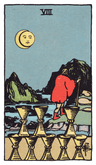
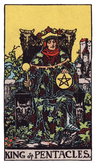
Next door in Pentacles
The other Fours
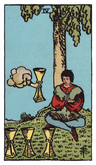
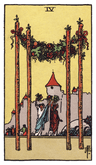
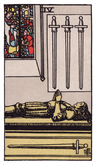
Shares its themes
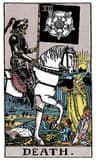
Four of Pentacles Symbolism
Interpretive Traditions
Different schools of tarot bring different lenses to the Four of Pentacles. These are perspectives, not contradictions.
Rider-Waite-Smith
Waite saw this as the card of material security earned and now held carefully. He emphasised the tension between security (which is good) and rigidity (which prevents growth). The fortress suggests both protection and imprisonment.
Thoth
In Crowley's system, this represents the manifestation of material power and security, but also the shadow: greed, control, and the illusion that external security can protect us from change.
Modern Intuitive
Contemporary readers often use this to explore the user's relationship with money and stability — whether their security practices are healthy or whether fear has made them rigid. It's a card that invites honest self-examination about control.
Four of Pentacles Keywords & Themes
The Four of Pentacles tarot card is associated with the following themes and keywords across upright and reversed positions: security, stability, consolidation, holding steady, conservation, stagnation, miserliness, hoarding, loss of security, rigidity. Its elemental correspondence is Earth. Astrologically it is linked to Capricorn.
Whether you drew the Four of Pentacles in a daily pull, a weekly spread, or a year-ahead reading, its core invitation is the same: to look honestly at what this card is reflecting in your own life. Tarot Digest uses the Four of Pentacles — and all 78 cards — as mirrors for self-inquiry, not prediction.
Recommended Decks & Books
Whether you're just starting with tarot or deepening a long practice, these are the decks and books most worth your time.
- 🃏
The Original Rider Waite Smith Tarot — A.E. Waite & Pamela Coleman Smith
The deck that defined modern tarot. First published in 1909, the RWS introduced illustrated pip cards for all 78 positions — a breakthrough that made tarot accessible to everyone. Every major deck since is either an homage or a reaction to it.
- 📖
Seventy-Eight Degrees of Wisdom — Rachel Pollack
The definitive companion to tarot, first published in 1980 and still the best single-volume guide. Pollack reads the cards as a living psychological system — the Major Arcana as a map of consciousness, the Minor as the terrain of daily life.
- 📖
The Creative Tarot — Jessa Crispin
A guide to using tarot as a tool for creative practice rather than divination — written for writers, artists, and makers. Crispin brings a sharp literary sensibility and treats the cards as a language for thinking about creative process.
- 🃏
Modern Witch Tarot Deck — Lisa Sterle
The RWS structure reimagined with diverse, contemporary figures in modern settings. Every symbol from the original is preserved (the Fool still stands at the cliff edge, the High Priestess still flanked by pillars), but the world looks like ours.
Links above may earn a small commission at no cost to you — affiliate code tarotdigest-20. Disclosure