
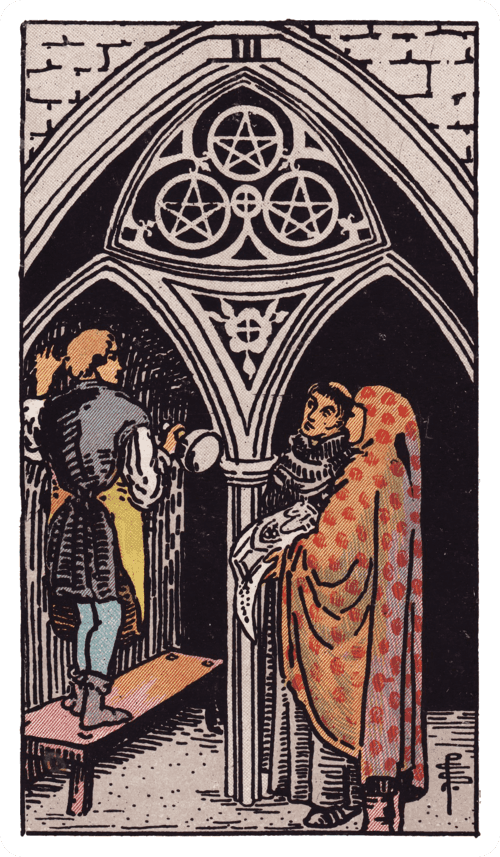
Pentacles · Minor Arcana
Three of Pentacles
Skilled collaboration, mastery emerging, work paying off
Go deeper with Three of Pentacles
The meanings below are a starting point. Bring what's actually on your mind and reflect on it here — what comes back is a question to sit with, never a forecast.
Reflection Room
Three of Pentacles · upright
Write and save if you'd rather sit with it alone. Nothing is sent.
Three of Pentacles Upright Meaning
The Three of Pentacles shows work that is both skilled and shared. In the RWS deck, a mason or craftsperson works with others — the emphasis is on the marriage of individual expertise with collective effort. This is the card of real results: a project moving forward, skills being recognised, work of quality taking shape. It points to the satisfaction that comes from doing something well and having others see and value that work. This might mean collaboration with others, or the internal satisfaction of knowing your own craft is improving. The Three invites pride in what you're building — not arrogance, but the earned dignity of doing real work well.
This card asks: what work are you doing (alone or with others) that you can actually take pride in — and are you letting yourself recognise the skill in it?
Three of Pentacles Reversed Meaning
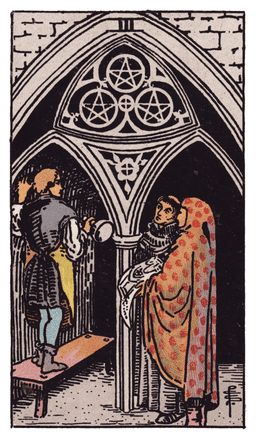
The Three reversed can signal work done alone that might benefit from others' input, or collaboration that has broken down. It might point to work that lacks quality, effort that's phoned in, or the frustration of having real skill but being in a situation where it's not valued or seen. Sometimes this card reversed suggests you're dismissing your own work as not good enough — when the real issue is that you're in the wrong context to have it recognised. It can also signal burnout in collaborative work, or resentment building because the balance of effort feels off.
This card invites you to notice: where is the work you're doing not being valued — and is that a sign to improve the work, find a different collaborator, or trust your own assessment more?
The Three of Pentacles in Love & Relationships
Upright
This card points to partnership that works because both people bring real skill to it — whether that's emotional attunement, practical care, or the ability to hold space. The question isn't whether you're in love, but whether you're building something together that you can both take pride in. Notice where your relationship asks something of you and you rise to meet it.
Reversed
You might be doing relational work that goes unrecognized, or you're in a dynamic where one person's effort is carrying more weight. Sometimes this card reversed suggests resentment building quietly because the balance feels off — or that you're dismissing your own care as not enough. Ask yourself whether the problem is that you're not trying hard enough, or that you're trying hard in a context that can't see it.
The Three of Pentacles in Work & Career
Upright
You're doing work that has actual quality to it, and this card asks you to let yourself know that. Whether you're collaborating well with others or watching your own skills sharpen, there's something worth recognizing here. The satisfaction comes not from external validation alone, but from the honest knowledge that what you're making or doing is done well.
Reversed
Your work might be suffering from isolation — you have the skill, but you're not getting feedback or input that could push it forward. Or collaboration has soured, and resentment is starting to calcify. It's also possible you're in a role where real competence goes unseen, which is a genuine problem — but notice whether the answer is to improve the work, find better collaborators, or move to a context that can recognize what you actually do.
Three of Pentacles: Yes or No?
Leans toward yes — and the better question underneath is whether this is work (or collaboration, or partnership) you can actually take pride in, or whether you'd be saying yes to something that diminishes your sense of craft.
Yes-or-no readings are the one place tarot pretends to be a fortune teller. We answer the question, then hand you the better one underneath it — that's the part worth your time.
Questions to ask when you draw Three of Pentacles
- What work or effort in this situation are you doing well, and are you letting yourself acknowledge it?
- If this involves others, is the balance of skill and effort one where both people can feel the work is real?
- What would need to shift for you to feel genuinely proud of what's being built here?
Cards near Three of Pentacles
Next door in Pentacles
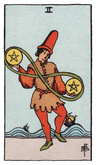
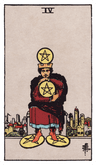
The other Threes
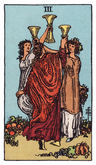
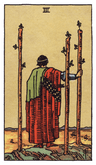
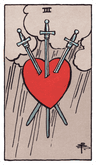
Shares its themes
Three of Pentacles Symbolism
Interpretive Traditions
Different schools of tarot bring different lenses to the Three of Pentacles. These are perspectives, not contradictions.
Rider-Waite-Smith
Waite emphasised this as the card of learning and craft — the moment when raw skill begins to become recognised mastery. The presence of other figures suggests mentorship, collaboration, and the value of working within a tradition or community.
Thoth
In Crowley's system, this represents the material manifestation of skill — work made manifest and recognised. The three-fold nature speaks to the conjunction of body, mind, and spirit in real craft.
Modern Intuitive
Contemporary readers often interpret this as a sign of progress and validation — permission to take your work seriously and to seek feedback from people whose opinions matter. It can also represent the beginning of building something that lasts.
Three of Pentacles Keywords & Themes
The Three of Pentacles tarot card is associated with the following themes and keywords across upright and reversed positions: collaboration, craftsmanship, quality work, recognition, mastery beginning, unrecognised effort, poor collaboration, lack of quality, isolation, mediocrity. Its elemental correspondence is Earth. Astrologically it is linked to Virgo.
Whether you drew the Three of Pentacles in a daily pull, a weekly spread, or a year-ahead reading, its core invitation is the same: to look honestly at what this card is reflecting in your own life. Tarot Digest uses the Three of Pentacles — and all 78 cards — as mirrors for self-inquiry, not prediction.
Recommended Decks & Books
Whether you're just starting with tarot or deepening a long practice, these are the decks and books most worth your time.
- 🃏
The Original Rider Waite Smith Tarot — A.E. Waite & Pamela Coleman Smith
The deck that defined modern tarot. First published in 1909, the RWS introduced illustrated pip cards for all 78 positions — a breakthrough that made tarot accessible to everyone. Every major deck since is either an homage or a reaction to it.
- 📖
Seventy-Eight Degrees of Wisdom — Rachel Pollack
The definitive companion to tarot, first published in 1980 and still the best single-volume guide. Pollack reads the cards as a living psychological system — the Major Arcana as a map of consciousness, the Minor as the terrain of daily life.
- 📖
The Creative Tarot — Jessa Crispin
A guide to using tarot as a tool for creative practice rather than divination — written for writers, artists, and makers. Crispin brings a sharp literary sensibility and treats the cards as a language for thinking about creative process.
- 🃏
Modern Witch Tarot Deck — Lisa Sterle
The RWS structure reimagined with diverse, contemporary figures in modern settings. Every symbol from the original is preserved (the Fool still stands at the cliff edge, the High Priestess still flanked by pillars), but the world looks like ours.
Links above may earn a small commission at no cost to you — affiliate code tarotdigest-20. Disclosure