
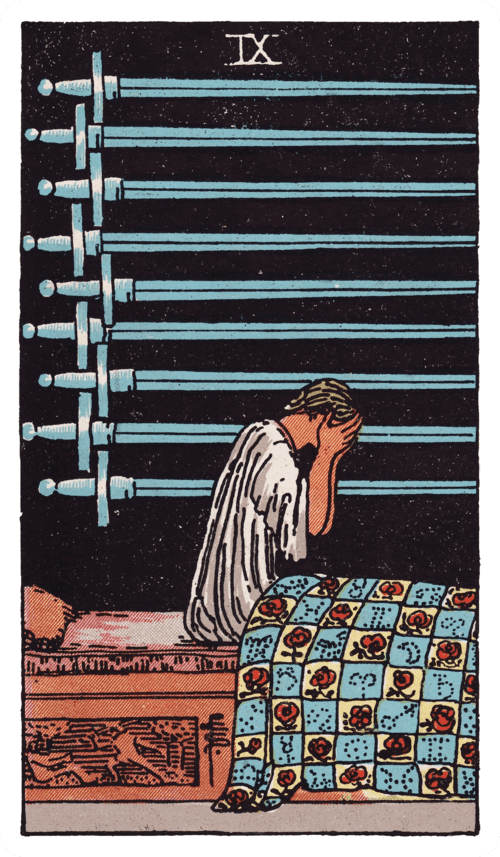
Swords · Minor Arcana
Nine of Swords
Nightmares, despair, the dark night of the soul, mental anguish
Go deeper with Nine of Swords
The meanings below are a starting point. Bring what's actually on your mind and reflect on it here — what comes back is a question to sit with, never a forecast.
Reflection Room
Nine of Swords · upright
Write and save if you'd rather sit with it alone. Nothing is sent.
Nine of Swords Upright Meaning
The Nine of Swords names an experience that lives in darkness — the moment when your own mind becomes your worst enemy, when thoughts loop into despair, when anxiety has weight and colour and feels absolutely true. This card doesn't minimise that experience. It says: this is real. The anguish you're feeling is genuine. And it also says: this is not the whole truth, even though it feels like it right now. The mind at its most distressed is not a reliable guide to reality. You need help, rest, and compassion — particularly from yourself. This darkness can move.
This card as a mirror: what story is your mind telling you in the dark? Is that story actually true, or does it become true only when you believe it?
Nine of Swords Reversed Meaning
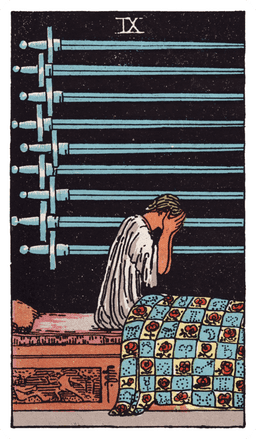
The Nine of Swords reversed often marks the moment when the darkness begins to lift — either gradually or suddenly. The nightmare is ending. You're waking up. It might be that the circumstances have genuinely improved, or simply that your capacity to carry what's happening has grown and the weight feels lighter. The invitation is to notice: the night is passing. You survived the darkness. There is dawn coming.
This card as a mirror: what's beginning to feel bearable that wasn't before? What relief is arriving?
The Nine of Swords in Love & Relationships
Upright
You might be caught in a narrative about what your relationship means or where it's headed, and that story has taken on a weight that feels unquestionable. Before you act on it, it's worth asking: is this thought pattern something you recognize from other parts of your life? Sometimes the mind in distress tells the same story no matter what the actual person across from you is doing.
Reversed
Something about the relationship is becoming easier to sit with, or your capacity to handle its complications has quietly grown. The shift might be external (an actual conversation happened, a boundary was set) or internal (you stopped bracing against something). Either way, notice what's begun to feel survivable.
The Nine of Swords in Work & Career
Upright
You're in a loop of thoughts about your work — whether that's about your competence, your future there, or what others think of you. The anxiety feels like evidence, like proof that something is wrong. The invitation is to separate the thought from the fact: what's actually happening at work, and what story your anxious mind is layering over it?
Reversed
The dread that surrounded your work situation is lifting, or at least becoming less total. This might mean the circumstances improved, or it might mean you've found a way to function despite them. Either way, you're not carrying the same weight. What's different about how you're moving through your days?
Nine of Swords: Yes or No?
Leans toward no — and the better question underneath is: what anxious story am I treating as fact right now, and what would I need to know before I act on it?
Yes-or-no readings are the one place tarot pretends to be a fortune teller. We answer the question, then hand you the better one underneath it — that's the part worth your time.
Questions to ask when you draw Nine of Swords
- What thought keeps you awake, and where else in your life does that same thought appear?
- If your mind is lying to you right now, what would the truth actually look like?
- What small thing would need to happen for you to believe the darkness can move?
Cards near Nine of Swords
Next door in Swords
The other Nines
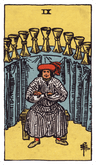
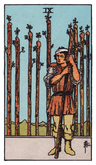
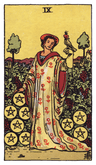
Shares its themes
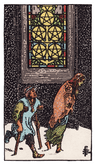
Nine of Swords Symbolism
Interpretive Traditions
Different schools of tarot bring different lenses to the Nine of Swords. These are perspectives, not contradictions.
Rider-Waite-Smith
Waite named this card as the darkest in the deck — not cruelty from outside but the horror of being imprisoned in your own mind. He noted that despite how real the despair feels, dawn always comes. The card holds both the reality of the anguish and the promise that it moves.
Thoth
Crowley associated the Nine of Swords with the principle of maturity in Air — the full development of thought's capacity to torment itself. This is not punishment; it's the natural shadow of being a thinking creature. The gift is in surviving and integrating the darkness.
Modern Intuitive
Contemporary readers, particularly those who work with depression and anxiety, often frame this card as validation — your suffering is real, and you deserve support. The card also carries an implicit message: this will pass. You have survived every dark moment until now.
Nine of Swords Keywords & Themes
The Nine of Swords tarot card is associated with the following themes and keywords across upright and reversed positions: despair, anxiety, nightmares, dark thoughts, mental anguish, the dark night of the soul, relief arriving, dawn coming, darkness lifting, recovery possible, the nightmare ending, resilience. Its elemental correspondence is Air.
Whether you drew the Nine of Swords in a daily pull, a weekly spread, or a year-ahead reading, its core invitation is the same: to look honestly at what this card is reflecting in your own life. Tarot Digest uses the Nine of Swords — and all 78 cards — as mirrors for self-inquiry, not prediction.
Recommended Decks & Books
Whether you're just starting with tarot or deepening a long practice, these are the decks and books most worth your time.
- 🃏
The Original Rider Waite Smith Tarot — A.E. Waite & Pamela Coleman Smith
The deck that defined modern tarot. First published in 1909, the RWS introduced illustrated pip cards for all 78 positions — a breakthrough that made tarot accessible to everyone. Every major deck since is either an homage or a reaction to it.
- 📖
Seventy-Eight Degrees of Wisdom — Rachel Pollack
The definitive companion to tarot, first published in 1980 and still the best single-volume guide. Pollack reads the cards as a living psychological system — the Major Arcana as a map of consciousness, the Minor as the terrain of daily life.
- 📖
The Creative Tarot — Jessa Crispin
A guide to using tarot as a tool for creative practice rather than divination — written for writers, artists, and makers. Crispin brings a sharp literary sensibility and treats the cards as a language for thinking about creative process.
- 🃏
Modern Witch Tarot Deck — Lisa Sterle
The RWS structure reimagined with diverse, contemporary figures in modern settings. Every symbol from the original is preserved (the Fool still stands at the cliff edge, the High Priestess still flanked by pillars), but the world looks like ours.
Links above may earn a small commission at no cost to you — affiliate code tarotdigest-20. Disclosure