
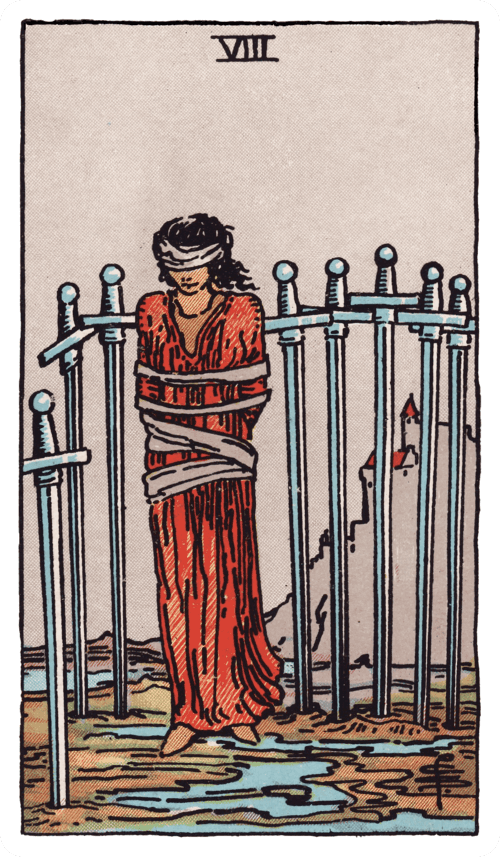
Swords · Minor Arcana
Eight of Swords
Mental imprisonment, anxiety, self-imposed limitations, trapped thinking
Go deeper with Eight of Swords
The meanings below are a starting point. Bring what's actually on your mind and reflect on it here — what comes back is a question to sit with, never a forecast.
Reflection Room
Eight of Swords · upright
Write and save if you'd rather sit with it alone. Nothing is sent.
Eight of Swords Upright Meaning
The Eight of Swords names something real: the experience of being mentally trapped. This might be anxiety that loops and traps you, a belief system that constrains your choices, or the way you've internalised someone else's judgment and now police yourself with their words. The difficult truth this card offers is that many of these prisons are self-made — not because you're weak, but because your mind is powerful and can convince you of almost anything. The invitation isn't to blame yourself. It's to notice: where are the actual walls, and where are you only seeing walls because you've been told they're there?
This card as a mirror: what are you telling yourself you can't do? What would be possible if you examined one of those limits more carefully?
Eight of Swords Reversed Meaning
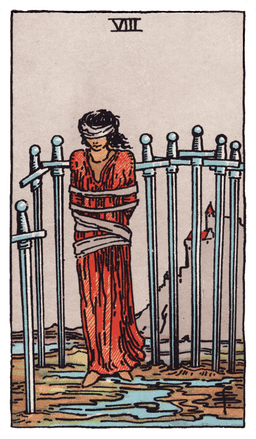
The Eight of Swords reversed often marks the moment when you see the lock from the inside and realise it's not actually locked — or that you have the key. This might be a sudden insight that a fear isn't as solid as you thought, or the gradual loosening of a limiting belief. Sometimes this card points to external help arriving — someone showing you a way out you couldn't see alone. The invitation is to trust: you can move. The restraints have more power in your mind than in your actual circumstances.
This card as a mirror: what's becoming possible now that you're beginning to see beyond the limitation? What would you choose if you knew you could?
The Eight of Swords in Love & Relationships
Upright
You might be operating from a story about what you can or can't ask for, what you're allowed to want, or how you need to behave to keep someone close. This card invites you to notice which of those rules actually came from the other person, and which ones you've been enforcing on yourself. The real question isn't whether the relationship is good — it's whether you're being honest about what you need.
Reversed
Something is shifting in how you see your own role in the dynamic. You might be recognising that a fear you thought was fixed was actually something you could question, or that you've been smaller than you needed to be. This often arrives as a quiet realisation rather than a dramatic change, but it opens space for you to ask for what matters.
The Eight of Swords in Work & Career
Upright
You're working within limits you may have stopped questioning. These could be beliefs about what you're qualified for, what's possible in your role, or what asking for what you want would cost you. The card asks: which of these boundaries are real constraints, and which are assumptions you've accepted without testing them?
Reversed
You're beginning to see that a barrier you thought was immovable has more give than you expected. This might come from new information, someone else showing you a different path, or simply your own willingness to look at the situation differently. The work now is to act on what you're seeing, not just to see it.
Eight of Swords: Yes or No?
Leans toward no — and the better question underneath is: what am I believing about what's possible that's worth examining more carefully?
Yes-or-no readings are the one place tarot pretends to be a fortune teller. We answer the question, then hand you the better one underneath it — that's the part worth your time.
Questions to ask when you draw Eight of Swords
- What rule or limit am I enforcing on myself that no one actually told me I had to follow?
- If I knew I could move, what would I want to do differently in this situation?
- Where am I confusing a fear with an actual barrier?
Cards near Eight of Swords
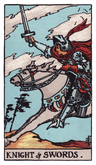
Next door in Swords
The other Eights
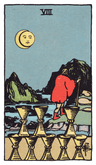
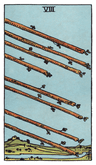
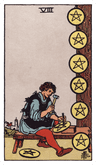
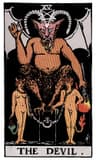
Shares its themes
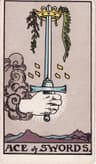
Eight of Swords Symbolism
Interpretive Traditions
Different schools of tarot bring different lenses to the Eight of Swords. These are perspectives, not contradictions.
Rider-Waite-Smith
Waite read the Eight of Swords as restriction and anxiety — with the psychological insight that much of the restriction is mental rather than actual. The card invites the viewer to question what's really constraining them and what's an internalised belief.
Thoth
Crowley associated this card with Hod in Air — the mind trapped in its own patterns, unable to think beyond the thoughts it's already thought. This is the mind in a loop, working against its own expansion.
Modern Intuitive
Contemporary readers, particularly those working with anxiety and trauma, often frame this card as a moment to check: is this a real constraint or a belief? The card is compassionate — it doesn't blame you for the prison — but it invites you to examine the walls.
Eight of Swords Keywords & Themes
The Eight of Swords tarot card is associated with the following themes and keywords across upright and reversed positions: mental imprisonment, anxiety loops, self-limitation, inner critic, trapped thinking, paralysis by analysis, breaking free, seeing the escape, mental clarity, recognising limiting beliefs, liberation. Its elemental correspondence is Air.
Whether you drew the Eight of Swords in a daily pull, a weekly spread, or a year-ahead reading, its core invitation is the same: to look honestly at what this card is reflecting in your own life. Tarot Digest uses the Eight of Swords — and all 78 cards — as mirrors for self-inquiry, not prediction.
Recommended Decks & Books
Whether you're just starting with tarot or deepening a long practice, these are the decks and books most worth your time.
- 🃏
The Original Rider Waite Smith Tarot — A.E. Waite & Pamela Coleman Smith
The deck that defined modern tarot. First published in 1909, the RWS introduced illustrated pip cards for all 78 positions — a breakthrough that made tarot accessible to everyone. Every major deck since is either an homage or a reaction to it.
- 📖
Seventy-Eight Degrees of Wisdom — Rachel Pollack
The definitive companion to tarot, first published in 1980 and still the best single-volume guide. Pollack reads the cards as a living psychological system — the Major Arcana as a map of consciousness, the Minor as the terrain of daily life.
- 📖
The Creative Tarot — Jessa Crispin
A guide to using tarot as a tool for creative practice rather than divination — written for writers, artists, and makers. Crispin brings a sharp literary sensibility and treats the cards as a language for thinking about creative process.
- 🃏
Modern Witch Tarot Deck — Lisa Sterle
The RWS structure reimagined with diverse, contemporary figures in modern settings. Every symbol from the original is preserved (the Fool still stands at the cliff edge, the High Priestess still flanked by pillars), but the world looks like ours.
Links above may earn a small commission at no cost to you — affiliate code tarotdigest-20. Disclosure