
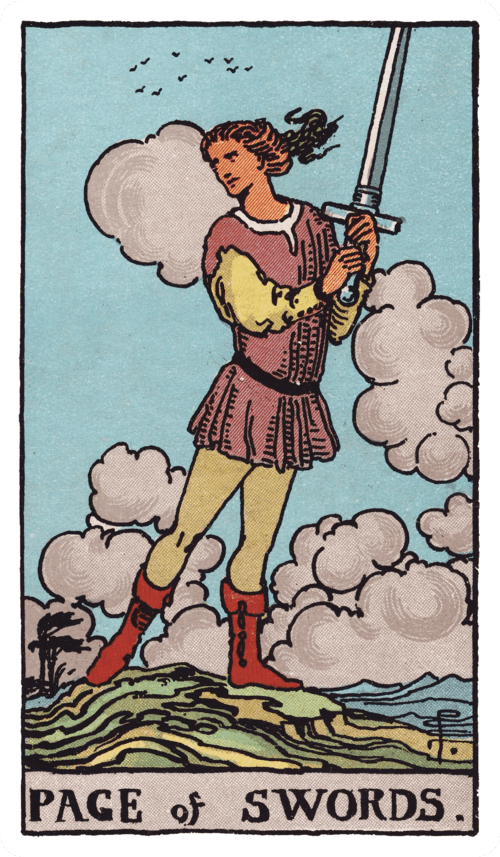
Swords · Minor Arcana
Page of Swords
Intellectual curiosity, fresh thinking, truth-seeking energy
Also known as
Thoth: Princess of Swords — Crowley's Princess of Swords carries the same vigilant, questioning energy as the Page. 'Princess of Swords' in a Thoth resource = this card.
Historical / pre-Waite: Knave of Swords — The pre-Waite term for the fourth court card.
Go deeper with Page of Swords
The meanings below are a starting point. Bring what's actually on your mind and reflect on it here — what comes back is a question to sit with, never a forecast.
Reflection Room
Page of Swords · upright
Write and save if you'd rather sit with it alone. Nothing is sent.
Page of Swords Upright Meaning
The Page of Swords brings a sharp, restless mind to any situation — the part of you that wants to understand, question, and investigate. This card's energy is curious without being cynical, direct without being cruel. It invites you to approach something in your life with fresh eyes and genuine inquiry rather than assumption or habit. There is real power in being willing to ask the uncomfortable question.
Where in your life right now would it serve you to approach something with a genuinely open and questioning mind — setting aside what you think you already know?
Page of Swords Reversed Meaning
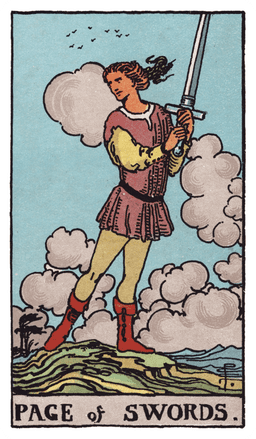
The Page of Swords reversed often points to the shadow of a sharp mind: words used carelessly, information gathered without wisdom about how to use it, or restless mental energy that can't settle long enough to go deep. It can also reflect a tendency toward gossip or snark — the intellect as social weapon rather than tool of understanding. The question isn't whether you're smart. It's whether your intelligence is in service of something real.
Is there a place in your life right now where your thinking is scattered, or where you're using words — to yourself or others — in ways that aren't actually honest or kind?
The Page of Swords in Love & Relationships
Upright
This card asks whether you're actually listening in your relationship, or operating from old assumptions about your partner. The Page of Swords upright is curious about the other person — it wants to understand what they think, what they need, what they've changed their mind about. Where could you ask a real question instead of assuming you already know the answer?
Reversed
When the Page is reversed in love, it often shows up as mental noise standing in for actual intimacy: rehashing old arguments, building cases in your head, or using words to wound rather than connect. It can also mean you're not listening closely because you're too busy formulating your response. Notice whether your mind is actually present with the other person, or somewhere else entirely.
The Page of Swords in Work & Career
Upright
You're in a position to learn something, ask something, or see something your workplace hasn't noticed yet. This card rewards the person who stays genuinely curious rather than cynical, who investigates a problem without ego, who asks the question others are too tired or afraid to ask. What would change if you approached your current work challenge like you're trying to understand it, not prove something?
Reversed
Your thinking may be scattered across too many projects or information sources, leaving you without depth in any of them. Or you might be using your intelligence strategically in ways that feel clever in the moment but aren't building real credibility or trust. Ask yourself: am I gathering information to solve something, or to have ammunition? Am I thinking clearly, or just thinking a lot?
Page of Swords: Yes or No?
Leans toward yes — and the better question underneath is whether you're asking this from genuine curiosity or from a need to be right.
Yes-or-no readings are the one place tarot pretends to be a fortune teller. We answer the question, then hand you the better one underneath it — that's the part worth your time.
Questions to ask when you draw Page of Swords
- What would you need to believe differently about this situation in order to see it clearly?
- Where are you using your intelligence as a defense instead of as a tool?
- What question have you been too afraid or too certain to actually ask?
Cards near Page of Swords
Next door in Swords
The other Pages
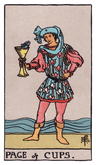
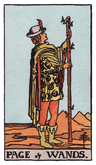
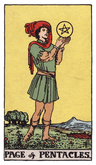
Shares its themes
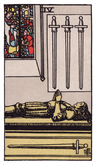
Page of Swords Symbolism
Interpretive Traditions
Different schools of tarot bring different lenses to the Page of Swords. These are perspectives, not contradictions.
Rider-Waite-Smith
Waite described the Page of Swords as a vigilant, active figure — someone who brings news, who is always watching. The card has associations with espionage, with secrets, with the gathering of intelligence. At its best, this is the energy of the journalist or the researcher — someone committed to getting to the truth of things.
Thoth
In the Thoth system this card is the Princess of Swords — associated with the earthy part of Air, the application of mental energy to practical problems. Crowley emphasised the combative aspect: this figure is quick to argue, quick to challenge, and not always aware of the social cost of that directness.
Modern Intuitive
Contemporary readers often use the Page of Swords to represent the energy of genuine intellectual curiosity — the willingness to be a beginner, to not know yet, to ask the question before reaching for the answer. It's a card that invites fresh thinking about something that might have calcified into habit or assumption.
Page of Swords Keywords & Themes
The Page of Swords tarot card is associated with the following themes and keywords across upright and reversed positions: intellectual curiosity, fresh perspective, truth-seeking, directness, mental restlessness, mental scatter, gossip, careless communication, restlessness, intellect without depth. Its elemental correspondence is Air. Astrologically it is linked to Gemini.
Whether you drew the Page of Swords in a daily pull, a weekly spread, or a year-ahead reading, its core invitation is the same: to look honestly at what this card is reflecting in your own life. Tarot Digest uses the Page of Swords — and all 78 cards — as mirrors for self-inquiry, not prediction.
Recommended Decks & Books
Whether you're just starting with tarot or deepening a long practice, these are the decks and books most worth your time.
- 🃏
The Original Rider Waite Smith Tarot — A.E. Waite & Pamela Coleman Smith
The deck that defined modern tarot. First published in 1909, the RWS introduced illustrated pip cards for all 78 positions — a breakthrough that made tarot accessible to everyone. Every major deck since is either an homage or a reaction to it.
- 📖
Seventy-Eight Degrees of Wisdom — Rachel Pollack
The definitive companion to tarot, first published in 1980 and still the best single-volume guide. Pollack reads the cards as a living psychological system — the Major Arcana as a map of consciousness, the Minor as the terrain of daily life.
- 📖
The Creative Tarot — Jessa Crispin
A guide to using tarot as a tool for creative practice rather than divination — written for writers, artists, and makers. Crispin brings a sharp literary sensibility and treats the cards as a language for thinking about creative process.
- 🃏
Modern Witch Tarot Deck — Lisa Sterle
The RWS structure reimagined with diverse, contemporary figures in modern settings. Every symbol from the original is preserved (the Fool still stands at the cliff edge, the High Priestess still flanked by pillars), but the world looks like ours.
Links above may earn a small commission at no cost to you — affiliate code tarotdigest-20. Disclosure