
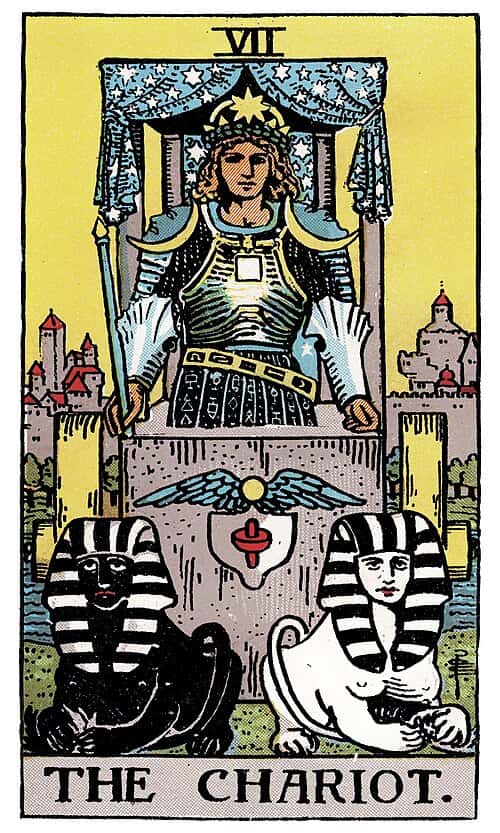
VII · Major Arcana
The Chariot
Willpower, momentum, self-mastery, directed action, victory
Go deeper with The Chariot
The meanings below are a starting point. Bring what's actually on your mind and reflect on it here — what comes back is a question to sit with, never a forecast.
Reflection Room
The Chariot · upright
Write and save if you'd rather sit with it alone. Nothing is sent.
The Chariot Upright Meaning
The Chariot invites you into the power of directed will. Notice: the Charioteer holds no reins. The sphinxes are controlled not by force but by pure presence and intention. This card is about moving forward despite the pull of conflicting desires or doubts. It's the realisation that you don't need all parts of yourself to agree — you just need enough centred will to move.
This card as a mirror: where in your life do you have both the goal and the ability, but keep losing momentum to internal conflict — and what would shift if you moved forward while holding that tension?
The Chariot Reversed Meaning
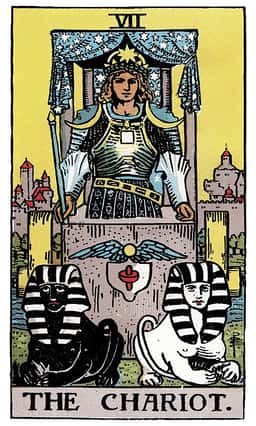
The Chariot reversed often points to momentum that's collapsed — or a will that's turned inward against itself. You might feel pulled in different directions with no clear victor, or perhaps you're trying so hard to control everything that the vehicle has stalled. Sometimes this reversal surfaces the original truth: you can't move forward while bracing against yourself.
This card as a mirror: where are you working against yourself — and what would it take to align your will toward a single purpose?
The Chariot in Love & Relationships
Upright
You have clarity about what you want from this relationship and the momentum to pursue it, but notice what you're holding in tension — maybe your need for independence against your desire for closeness, or your vision for the future against your partner's. The Chariot asks: are you moving forward while acknowledging these pulls, or pretending they don't exist?
Reversed
You may feel stuck because you're working against yourself — wanting connection while protecting against hurt, or pushing for change while fearing it. The stall often comes not from your partner but from the conflict between what you want and what you're afraid to want. What would it look like to stop bracing and choose a single direction?
The Chariot in Work & Career
Upright
You know where you're headed and have the capability to get there, but you're likely managing competing priorities or doubts about the path. The question isn't whether you can move forward — it's whether you're willing to do so while holding that internal friction rather than waiting for everything to feel certain.
Reversed
Your momentum has stalled, often because you're trying to control too many variables at once or you're divided about what you actually want. You might be caught between playing it safe and taking the leap, or between someone else's expectations and your own. The block is self-imposed rather than external.
The Chariot: Yes or No?
Leans toward yes — and the better question underneath is: can you move toward this goal while holding whatever doubts or conflicts you're carrying, rather than waiting for perfect alignment?
Yes-or-no readings are the one place tarot pretends to be a fortune teller. We answer the question, then hand you the better one underneath it — that's the part worth your time.
Questions to ask when you draw The Chariot
- What part of yourself are you requiring to agree before you move forward, and what would it cost to move anyway?
- Where in your life right now is your will turned against itself, and what would single-pointed intention feel like?
- What conflicting desire or doubt is slowing you down — and is it actually blocking you, or just making the journey feel harder?
Cards near The Chariot
Beside it on the Fool's Journey
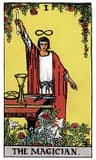
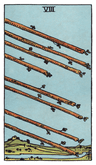
Shares its number: the Sevens
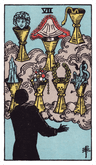
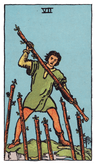
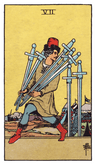
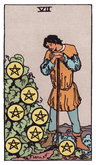
Shares its themes
The Chariot Symbolism
Interpretive Traditions
Different schools of tarot bring different lenses to The Chariot. These are perspectives, not contradictions.
Rider-Waite-Smith
Waite's Chariot represents the triumph of will and determination — but not in a crude way. The card emphasises that victory comes through self-mastery, through the maturation that allows you to hold opposites in balance and move forward anyway.
Thoth
Crowley's Chariot represents the functioning will — the command principle expressing itself as directed motion. More cosmic and abstract than Waite's version; the focus is on the principle of will itself rather than its personal expression.
Modern Intuitive
Contemporary readers often frame the Chariot as permission to commit — to decide, to move, to stop negotiating with the parts of yourself that are afraid. The card validates that clarity and momentum are available to you if you can centre yourself enough to claim them.
Campbell parallel
The Crossing of the First Threshold
In your life
The Chariot appears when you need to move forward despite internal conflict — not by eliminating the contradiction but by holding it with enough directed will to move anyway. This card asks: where in your life are you losing momentum to internal fragmentation, and what would it feel like to move forward while holding that tension?
The Chariot Keywords & Themes
The Chariot tarot card is associated with the following themes and keywords across upright and reversed positions: directed will, momentum, self-mastery, focus, overcoming obstacles, victory, loss of control, scattered energy, blocked momentum, internal conflict, self-sabotage. Its elemental correspondence is Water. Astrologically it is linked to Cancer. Its planetary ruler is Mars.
Whether you drew The Chariot in a daily pull, a weekly spread, or a year-ahead reading, its core invitation is the same: to look honestly at what this card is reflecting in your own life. Tarot Digest uses The Chariot — and all 78 cards — as mirrors for self-inquiry, not prediction.
Recommended Decks & Books
Whether you're just starting with tarot or deepening a long practice, these are the decks and books most worth your time.
- 🃏
The Original Rider Waite Smith Tarot — A.E. Waite & Pamela Coleman Smith
The deck that defined modern tarot. First published in 1909, the RWS introduced illustrated pip cards for all 78 positions — a breakthrough that made tarot accessible to everyone. Every major deck since is either an homage or a reaction to it.
- 📖
Seventy-Eight Degrees of Wisdom — Rachel Pollack
The definitive companion to tarot, first published in 1980 and still the best single-volume guide. Pollack reads the cards as a living psychological system — the Major Arcana as a map of consciousness, the Minor as the terrain of daily life.
- 📖
The Creative Tarot — Jessa Crispin
A guide to using tarot as a tool for creative practice rather than divination — written for writers, artists, and makers. Crispin brings a sharp literary sensibility and treats the cards as a language for thinking about creative process.
- 🃏
Modern Witch Tarot Deck — Lisa Sterle
The RWS structure reimagined with diverse, contemporary figures in modern settings. Every symbol from the original is preserved (the Fool still stands at the cliff edge, the High Priestess still flanked by pillars), but the world looks like ours.
Links above may earn a small commission at no cost to you — affiliate code tarotdigest-20. Disclosure