
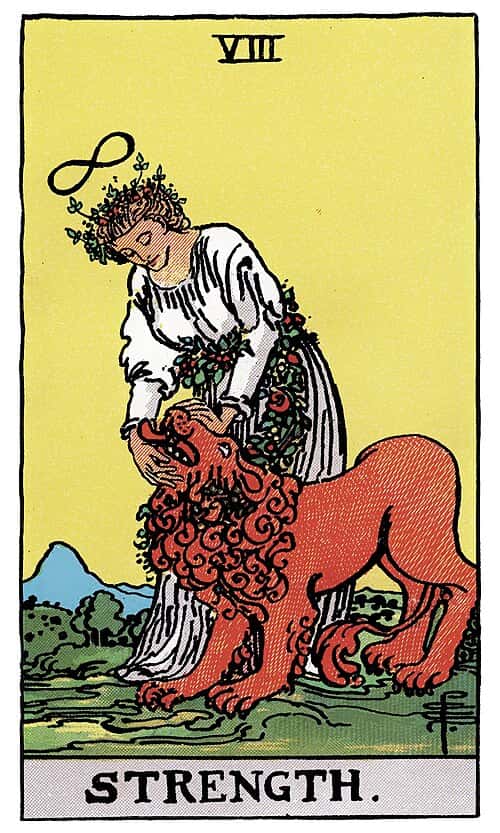
VIII · Major Arcana
Strength
Inner strength, gentleness, compassionate power, patience
Also known as
Thoth: Lust — Crowley renamed Strength to 'Lust' — not in the carnal sense, but to invoke the ecstatic, sacred life-force of the card's imagery. Same archetype, very different word. Don't be put off by the name.
Marseille / Historical: La Force / Strength (XI) — In the original Marseille tradition, Strength is numbered XI and Justice is VIII. Waite reversed this order. Some modern decks follow the Marseille numbering, so you may see Strength labelled as either VIII or XI depending on the deck.
Go deeper with Strength
The meanings below are a starting point. Bring what's actually on your mind and reflect on it here — what comes back is a question to sit with, never a forecast.
Reflection Room
Strength · upright
Write and save if you'd rather sit with it alone. Nothing is sent.
Strength Upright Meaning
Strength invites you to recognise a kind of courage that lives quietly beneath the surface — the courage that comes not from force but from love. This card appears when you're facing something that feels like an obstacle or an enemy: an impulse, an emotion, a situation that seems too large to hold. It asks: what if you stopped fighting it and started listening to it instead? True strength, this card suggests, lives in the willingness to be patient with what is difficult, to approach with tenderness what you've been treating as a threat.
This card as a mirror: what in your life are you trying to overcome through sheer willpower — and what might happen if you approached it with curiosity and compassion instead?
Strength Reversed Meaning
Strength reversed often surfaces when you've lost faith in your own gentler resources — when you're pushing harder instead of listening deeper. It can point to situations where you're trying to force an outcome that doesn't want to be forced, or where you've exhausted yourself trying to overcome something that might actually need a different approach. It can also suggest self-abandonment: treating your own needs or emotions as enemies to be conquered rather than parts of yourself asking to be heard.
This card as a mirror: where are you trying to win a battle that might actually need surrender, understanding, or rest?
The Strength in Love & Relationships
Upright
This card asks what you're fighting in your relationship — a partner's behavior, a pattern you hate in yourself, a distance that feels unbridgeable. The question isn't how to win, but what happens if you stop bracing against it. Strength suggests that the thing you've named as the problem might soften if you met it with patience instead of force.
Reversed
You might be exhausted from trying to change someone, or from treating your own needs as weaknesses to suppress. This reversal points to situations where you've stopped listening — to your partner, to yourself, or to what the relationship actually needs right now. The harder you push, the more stuck things become.
The Strength in Work & Career
Upright
At work, this card invites you to notice where you're muscling through something that might respond better to a different approach. A difficult colleague, a project that won't move, your own frustration — what if you sat with the obstacle rather than battling it? Strength here often means asking better questions instead of demanding faster results.
Reversed
You might be burning out trying to force progress, or abandoning your own judgment in favor of willpower alone. This card reversed suggests you've stopped trusting your instincts or your limits. It's worth asking whether you're pushing toward something you actually want, or away from something you're afraid of.
Strength: Yes or No?
Leans toward yes — and the better question underneath is whether what you're considering requires force, or whether it asks for patience and a willingness to listen.
Yes-or-no readings are the one place tarot pretends to be a fortune teller. We answer the question, then hand you the better one underneath it — that's the part worth your time.
Questions to ask when you draw Strength
- What am I treating as an enemy that might actually be asking for understanding?
- Where in my life have I stopped listening to myself, and what would happen if I started again?
- What would change if I approached this with curiosity instead of the need to win?
Cards near Strength
Beside it on the Fool's Journey
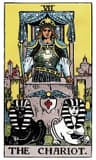
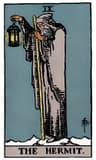
Shares its number: the Eights
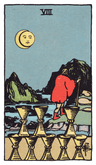
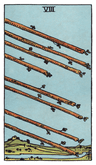
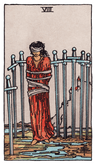
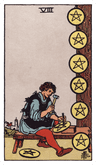
Shares its themes
Strength Symbolism
Interpretive Traditions
Different schools of tarot bring different lenses to the Strength. These are perspectives, not contradictions.
Rider-Waite-Smith
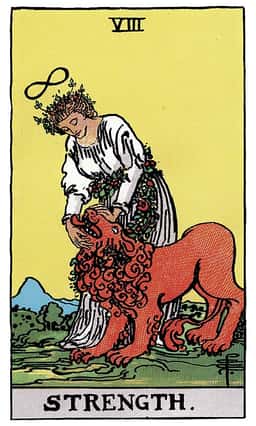
Pamela Colman Smith's illustration consciously moved away from the card's traditional association with brute force. The figure here embodies patience, not conquest. Waite described this as the strength that 'tames the wild animal of instinct by the power of gentleness and love.' It is psychological integration rather than external victory.
Thoth
Crowley placed this card at 11 (one position different from RWS) and associated it with Gebura — the sefirah of severity and will. But here the balance matters: the woman in the Thoth version is a cosmic force, showing that true power moves through you rather than from you. Strength is alignment with forces greater than the individual will.
Modern Intuitive
Contemporary readers emphasise the psychological dimensions: this card speaks to emotional regulation, shadow integration, and the power of accepting rather than fighting what arises. It appears often in the context of healing from shame — the recognition that all parts of us contain wisdom if we're willing to listen rather than condemn.
Campbell parallel
The Road of Trials — the test of inner resources
In your life
This card appears when you're facing something that feels overwhelming — an impulse, a situation, a part of yourself — and you're wondering whether you can hold it. What if the answer isn't to overcome it, but to befriend it? What if the strength you need is already available, but it looks like patience instead of power?
Strength Keywords & Themes
The Strength tarot card is associated with the following themes and keywords across upright and reversed positions: inner strength, gentleness, patience, compassion, working with difficulty rather than against it, self-doubt, forcing, impatience, inner conflict, exhaustion from struggle. Its elemental correspondence is Fire. Astrologically it is linked to Leo. Its planetary ruler is Sun.
Whether you drew the Strength in a daily pull, a weekly spread, or a year-ahead reading, its core invitation is the same: to look honestly at what this card is reflecting in your own life. Tarot Digest uses the Strength — and all 78 cards — as mirrors for self-inquiry, not prediction.
Recommended Decks & Books
Whether you're just starting with tarot or deepening a long practice, these are the decks and books most worth your time.
- 🃏
The Original Rider Waite Smith Tarot — A.E. Waite & Pamela Coleman Smith
The deck that defined modern tarot. First published in 1909, the RWS introduced illustrated pip cards for all 78 positions — a breakthrough that made tarot accessible to everyone. Every major deck since is either an homage or a reaction to it.
- 📖
Seventy-Eight Degrees of Wisdom — Rachel Pollack
The definitive companion to tarot, first published in 1980 and still the best single-volume guide. Pollack reads the cards as a living psychological system — the Major Arcana as a map of consciousness, the Minor as the terrain of daily life.
- 📖
The Creative Tarot — Jessa Crispin
A guide to using tarot as a tool for creative practice rather than divination — written for writers, artists, and makers. Crispin brings a sharp literary sensibility and treats the cards as a language for thinking about creative process.
- 🃏
Modern Witch Tarot Deck — Lisa Sterle
The RWS structure reimagined with diverse, contemporary figures in modern settings. Every symbol from the original is preserved (the Fool still stands at the cliff edge, the High Priestess still flanked by pillars), but the world looks like ours.
Links above may earn a small commission at no cost to you — affiliate code tarotdigest-20. Disclosure