
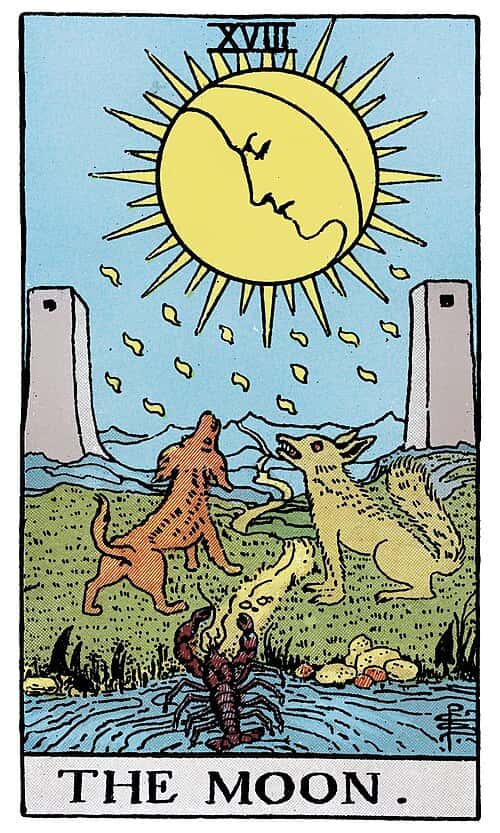
XVIII · Major Arcana
The Moon
Uncertainty, illusion, anxiety, navigating the unclear path
Go deeper with The Moon
The meanings below are a starting point. Bring what's actually on your mind and reflect on it here — what comes back is a question to sit with, never a forecast.
Reflection Room
The Moon · upright
Write and save if you'd rather sit with it alone. Nothing is sent.
The Moon Upright Meaning
This card invites you into the 3am of the journey — the space of genuine uncertainty where the mind generates fears that daylight would dissolve. You might be in a time of not knowing what comes next, or noticing how much of what you fear is a shape your anxious mind created rather than an actual threat. The Moon doesn't promise clarity. It asks you to keep moving despite the shadows, trusting that some paths reveal themselves only by walking them.
This card as a mirror: where are you currently in genuine uncertainty — and how much of what you're afraid of is real, and how much is your mind filling the unknown with worst-case shapes?
The Moon Reversed Meaning
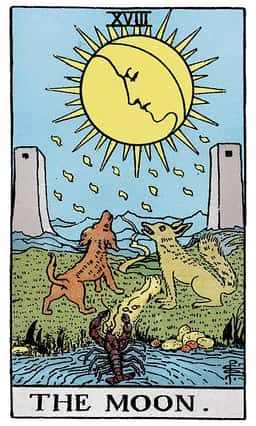
The Moon reversed often signals that clarity is beginning to break through — the anxious fog is lifting, or you're finally naming a fear that no longer has power over you. This card can also indicate that you're learning to distinguish between actual danger and the shadows cast by your own anxiety. Sometimes it suggests that you've been in illusion and are now beginning to see through it.
This card as a mirror: what illusion are you starting to see through — and what becomes possible as the fog clears?
The Moon in Love & Relationships
Upright
You might be caught in a loop of what-ifs about a relationship, or notice how much of your worry is story rather than fact. The Moon asks you to sit with not knowing how someone else feels or where things are heading, and to notice what fear feels like when it has nothing solid to grip.
Reversed
Clarity is arriving: maybe you're finally naming something you've been afraid to say, or you're seeing through a story you told yourself about what someone meant. As the fog clears, you get to decide what you actually want rather than what anxiety was deciding for you.
The Moon in Work & Career
Upright
You're in a phase where the next move isn't obvious, and your mind is probably filling that gap with worst-case scenarios about competence, timing, or fit. The useful question isn't whether you should stay or go, but what you can actually know right now versus what you're inventing.
Reversed
A confusion is resolving. You might be gaining clarity about what you actually want from your work, or seeing through a limiting belief about what's possible for you. Something that looked risky or unclear is becoming legible enough to act on.
The Moon: Yes or No?
Leans toward 'not yet' — and the better question underneath is: what do you need to know before you can decide, and what are you hoping the answer will magically settle for you?
Yes-or-no readings are the one place tarot pretends to be a fortune teller. We answer the question, then hand you the better one underneath it — that's the part worth your time.
Questions to ask when you draw The Moon
- What fear have you been treating as fact, and what would change if you tested it against what's actually true right now?
- Where in your life are you waiting for certainty before you move, and what small step could you take while still uncertain?
- What illusion or story about yourself or your situation are you beginning to see through?
Guides that talk about The Moon
Cards near The Moon
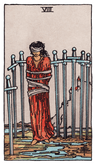
Shares its number: the Nines
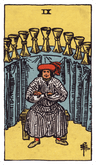
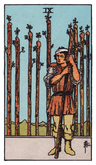
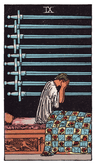
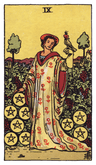
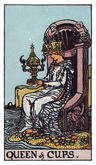
Shares its themes
The Moon Symbolism
Interpretive Traditions
Different schools of tarot bring different lenses to The Moon. These are perspectives, not contradictions.
Rider-Waite-Smith
Waite grounded the Moon in psychology — specifically the unconscious and the way the mind projects fears onto ambiguous stimuli. He intended the card as an exploration of anxiety not as prophecy but as a description of the human experience of uncertainty. The path is there; the terror is internal.
Thoth
Crowley's Moon emphasizes the cycles of manifestation and the way matter is shaped by the unconscious desires and fears we project. The card represents the journey through the reflected world of illusion toward actual reality. Frieda Harris's illustration is dreamlike, emphasizing the fluid, mutable nature of perception.
Modern Intuitive
Contemporary readers often frame the Moon as the invitation to develop courage in the face of uncertainty rather than waiting for certainty before acting. Many modern interpreters see it as a card about deepening intuition — learning to trust inner guidance when external clarity is unavailable.
Campbell parallel
The Road Back — navigating the still-shadowed path
In your life
The Moon appears in the liminal spaces of your life — the spaces where you don't yet know what's next, where your fear-generating mind is filling the blank with worst-case shapes, where you're asked to keep moving without full visibility. The path continues through this terrain. It doesn't ask you to see clearly. It asks you to keep walking.
The Moon Keywords & Themes
The Moon tarot card is associated with the following themes and keywords across upright and reversed positions: uncertainty, illusion, anxiety, working with the unconscious, the liminal space, fear and imagination, clarity emerging, facing fears directly, dispelling illusion, moving from anxiety to truth, naming what's real. Its elemental correspondence is Water. Astrologically it is linked to Pisces. Its planetary ruler is Neptune.
Whether you drew The Moon in a daily pull, a weekly spread, or a year-ahead reading, its core invitation is the same: to look honestly at what this card is reflecting in your own life. Tarot Digest uses The Moon — and all 78 cards — as mirrors for self-inquiry, not prediction.
Recommended Decks & Books
Whether you're just starting with tarot or deepening a long practice, these are the decks and books most worth your time.
- 🃏
The Original Rider Waite Smith Tarot — A.E. Waite & Pamela Coleman Smith
The deck that defined modern tarot. First published in 1909, the RWS introduced illustrated pip cards for all 78 positions — a breakthrough that made tarot accessible to everyone. Every major deck since is either an homage or a reaction to it.
- 📖
Seventy-Eight Degrees of Wisdom — Rachel Pollack
The definitive companion to tarot, first published in 1980 and still the best single-volume guide. Pollack reads the cards as a living psychological system — the Major Arcana as a map of consciousness, the Minor as the terrain of daily life.
- 📖
The Creative Tarot — Jessa Crispin
A guide to using tarot as a tool for creative practice rather than divination — written for writers, artists, and makers. Crispin brings a sharp literary sensibility and treats the cards as a language for thinking about creative process.
- 🃏
Modern Witch Tarot Deck — Lisa Sterle
The RWS structure reimagined with diverse, contemporary figures in modern settings. Every symbol from the original is preserved (the Fool still stands at the cliff edge, the High Priestess still flanked by pillars), but the world looks like ours.
Links above may earn a small commission at no cost to you — affiliate code tarotdigest-20. Disclosure