
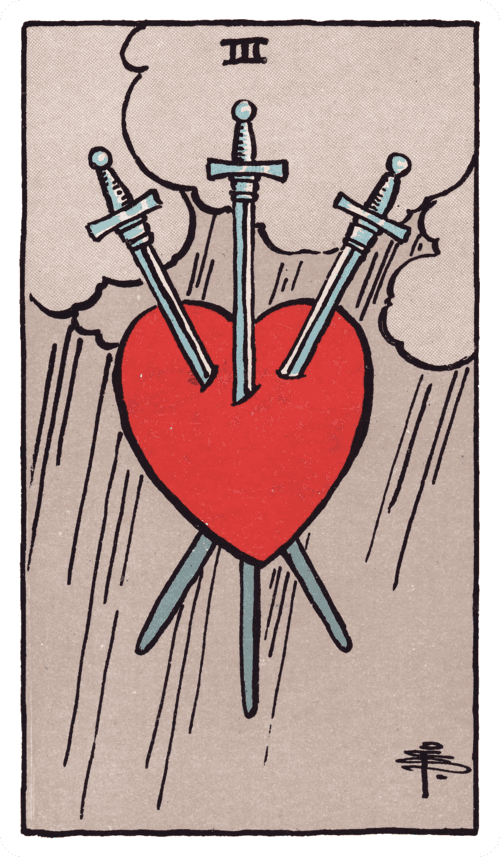
Swords · Minor Arcana
Three of Swords
Heartbreak, a painful truth revealed, sorrow of loss or separation
Go deeper with Three of Swords
The meanings below are a starting point. Bring what's actually on your mind and reflect on it here — what comes back is a question to sit with, never a forecast.
Reflection Room
Three of Swords · upright
Write and save if you'd rather sit with it alone. Nothing is sent.
Three of Swords Upright Meaning
The Three of Swords names something real: there is grief here. Not the slow erosion of sadness, but the sharp, immediate pain of a truth that cuts — a relationship ending, a trust broken, something good becoming clear that it was never going to work. This card doesn't soften the difficulty. You deserve to know that what you're feeling is real and valid. The invitation isn't to get over it quickly. It's to let yourself feel it fully and to notice what clarity it brings, even in its pain.
This card as a mirror: what truth are you grieving right now? What has become clear that you wish wasn't true?
Three of Swords Reversed Meaning
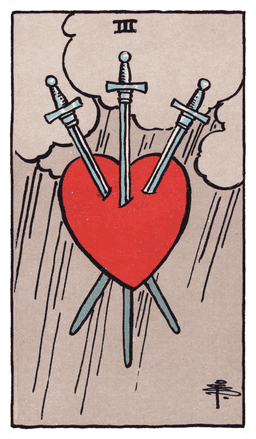
The Three of Swords reversed often marks the moment when the acute pain begins to shift into something you can carry. This doesn't mean the loss is healed; it means you're beginning to metabolise it. Sometimes reversed, this card points to a truth that isn't as dire as you feared, or to communication that repairs what seemed broken. The invitation is to notice: are you beginning to move through this, or are you still in the first shock?
This card as a mirror: what is slowly becoming bearable? What piece of this loss are you starting to integrate?
The Three of Swords in Love & Relationships
Upright
This card points to a specific moment: a conversation that can't be unheard, a pattern you can no longer ignore, or a choice that leaves pain in its wake. You're grieving something you needed to grieve. The work here isn't to move past it quickly, but to let yourself know what this sharpness is teaching you about what you need.
Reversed
The initial shock is softening into something you can think about without flinching quite so hard. A rupture may be healing through honest talk, or you're beginning to see that the situation wasn't as hopeless as it felt in the first cut. Notice what's becoming lighter: is it the pain itself, or your ability to carry it?
The Three of Swords in Work & Career
Upright
You're facing a clear truth about a job, a working relationship, or a path you thought was solid. This might be a firing, a betrayal by someone you trusted, or the recognition that something you built isn't what you believed it was. The three of swords doesn't ask you to stay numb. It asks you to feel the specific shape of this loss so you can move from it honestly.
Reversed
The initial sting of a workplace loss or disappointment is becoming something you can work with. You might be rebuilding a damaged working relationship, or you're slowly accepting a change that felt like failure. What once felt like a career ending is starting to look like a transition.
Three of Swords: Yes or No?
Leans toward no — and the better question underneath is: what does this situation need me to grieve or accept before I can move forward?
Yes-or-no readings are the one place tarot pretends to be a fortune teller. We answer the question, then hand you the better one underneath it — that's the part worth your time.
Questions to ask when you draw Three of Swords
- What truth about this situation are you still resisting?
- If you let yourself feel the full weight of this without trying to fix it, what would you know that you're currently avoiding?
- What would change if you stopped treating this pain as a problem and started treating it as information?
Guides that talk about Three of Swords
Cards near Three of Swords
Next door in Swords
The other Threes
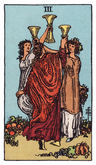
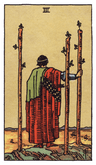
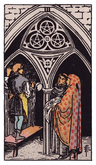
Shares its themes
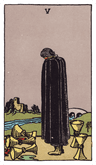
Three of Swords Symbolism
Interpretive Traditions
Different schools of tarot bring different lenses to the Three of Swords. These are perspectives, not contradictions.
Rider-Waite-Smith
Waite named this card as sorrow and heartbreak without exception. He considered it one of the hardest cards in the deck — not because it predicts tragedy, but because it names the reality of emotional pain that comes with human connection. When you love or commit, you risk this.
Thoth
Crowley associated the Three of Swords with Binah in Air — the principle of sorrow and the feminine power of receiving and containing pain. This isn't punishment; it's the depth that comes from being willing to feel fully.
Modern Intuitive
Contemporary readers often use this card to honour grief as a legitimate emotional territory, not a failure or weakness. The card says: you are grieving because you cared. That caring was real and good, even though it hurts now.
Three of Swords Keywords & Themes
The Three of Swords tarot card is associated with the following themes and keywords across upright and reversed positions: heartbreak, painful truth, loss, separation, grief, sorrow, honest pain, healing beginning, sorrow softening, moving through grief, repair possible, pain becoming wisdom. Its elemental correspondence is Air.
Whether you drew the Three of Swords in a daily pull, a weekly spread, or a year-ahead reading, its core invitation is the same: to look honestly at what this card is reflecting in your own life. Tarot Digest uses the Three of Swords — and all 78 cards — as mirrors for self-inquiry, not prediction.
Recommended Decks & Books
Whether you're just starting with tarot or deepening a long practice, these are the decks and books most worth your time.
- 🃏
The Original Rider Waite Smith Tarot — A.E. Waite & Pamela Coleman Smith
The deck that defined modern tarot. First published in 1909, the RWS introduced illustrated pip cards for all 78 positions — a breakthrough that made tarot accessible to everyone. Every major deck since is either an homage or a reaction to it.
- 📖
Seventy-Eight Degrees of Wisdom — Rachel Pollack
The definitive companion to tarot, first published in 1980 and still the best single-volume guide. Pollack reads the cards as a living psychological system — the Major Arcana as a map of consciousness, the Minor as the terrain of daily life.
- 📖
The Creative Tarot — Jessa Crispin
A guide to using tarot as a tool for creative practice rather than divination — written for writers, artists, and makers. Crispin brings a sharp literary sensibility and treats the cards as a language for thinking about creative process.
- 🃏
Modern Witch Tarot Deck — Lisa Sterle
The RWS structure reimagined with diverse, contemporary figures in modern settings. Every symbol from the original is preserved (the Fool still stands at the cliff edge, the High Priestess still flanked by pillars), but the world looks like ours.
Links above may earn a small commission at no cost to you — affiliate code tarotdigest-20. Disclosure