
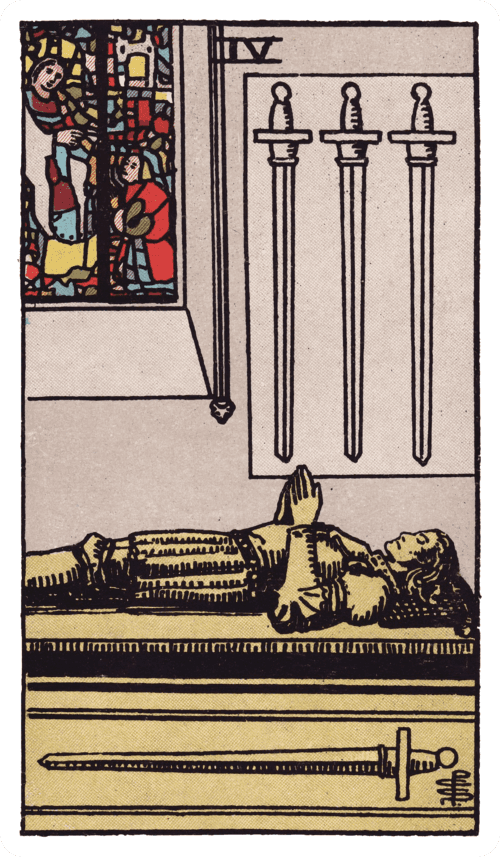
Swords · Minor Arcana
Four of Swords
Rest, truce, mental recovery, a pause in the struggle
Go deeper with Four of Swords
The meanings below are a starting point. Bring what's actually on your mind and reflect on it here — what comes back is a question to sit with, never a forecast.
Reflection Room
Four of Swords · upright
Write and save if you'd rather sit with it alone. Nothing is sent.
Four of Swords Upright Meaning
The Four of Swords invites you to rest — not because you're done, but because you need to be. This card recognises that thinking, deciding, and being in conflict with yourself or others is genuinely exhausting. Rest isn't laziness; it's strategic. Your mind needs the quiet to restore itself. This card gives you permission: you can put the swords down. You can stop being on guard. There will be time to pick them back up later.
This card as a mirror: what kind of mental rest do you actually need right now? What would it feel like to stop strategising, just for a moment?
Four of Swords Reversed Meaning
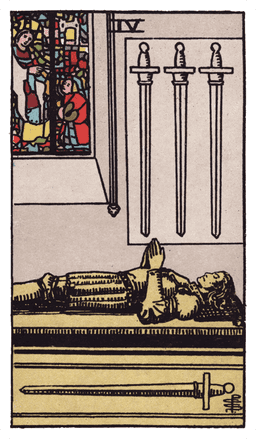
The Four of Swords reversed often points to an inability or refusal to rest — either because the conflict isn't over yet and you don't feel safe pausing, or because your mind won't quiet down. Sometimes this card reversed suggests you've rested too long and the stagnation is beginning to feel like entrapment. The invitation is to check: what do you actually need? Is it deeper rest, or is it actually time to engage again?
This card as a mirror: what's preventing you from resting? Is it that you're not ready, or that you're ready to move but haven't?
The Four of Swords in Love & Relationships
Upright
This card asks whether you're actually resting in your relationship, or still braced for conflict even when things are calm. Rest here means lowering your guard enough to be vulnerable — not strategising your next move or protecting yourself preemptively. What would it feel like to trust the quiet?
Reversed
You might be caught between two positions: unable to rest because unresolved tension still sits between you, or restless because you've been in stasis and something in you is ready to engage again. The card asks which one is true. Is the pause protective, or is it becoming avoidance?
The Four of Swords in Work & Career
Upright
Work demands constant mental output — decisions, problem-solving, managing others' ideas against yours. This card names that as legitimately exhausting and suggests you need actual downtime, not just weekend scrolling. Notice whether you're actually allowing yourself to stop thinking about work, or whether your mind is still running through scenarios.
Reversed
Either you can't pause because a project or conflict genuinely isn't resolved yet and stopping feels unsafe, or you've been in a holding pattern so long it's started to feel like your only option. The question is whether you need more rest to get clarity, or whether staying still has become the problem.
Four of Swords: Yes or No?
Leans toward no — and the better question underneath is whether you're asking about timing. This card isn't answering whether something will happen; it's asking what you need before you're ready to act on it.
Yes-or-no readings are the one place tarot pretends to be a fortune teller. We answer the question, then hand you the better one underneath it — that's the part worth your time.
Questions to ask when you draw Four of Swords
- What does mental rest actually look like for you, separate from just being physically inactive?
- Are you resting because you chose to pause, or because you're too exhausted to do anything else right now?
- If you stopped thinking about this situation for a week, what would be different when you came back to it?
Guides that talk about Four of Swords
Cards near Four of Swords
Next door in Swords
The other Fours
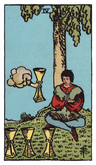
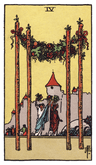
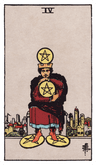
Shares its themes
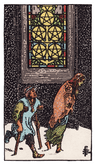
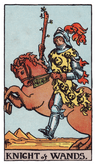
Four of Swords Symbolism
Interpretive Traditions
Different schools of tarot bring different lenses to the Four of Swords. These are perspectives, not contradictions.
Rider-Waite-Smith
Waite emphasised the Four of Swords as a card of truce and necessary respite. After the heartbreak of the Three, the Four says: stop. Rest. Your mind cannot work in a state of constant conflict. This is wisdom, not weakness.
Thoth
Crowley associated this card with Chokmah in Air — the principle of rest as creative necessity. The Four is where the mind consolidates what it's learned, integrates conflict into understanding, and prepares for the next engagement.
Modern Intuitive
Contemporary readers often frame the Four of Swords as permission to step back from the narrative, to stop analysing, and to let your nervous system settle. Particularly relevant for those with anxiety or rumination patterns.
Four of Swords Keywords & Themes
The Four of Swords tarot card is associated with the following themes and keywords across upright and reversed positions: rest, recovery, truce, mental respite, the necessity of pause, restoration, restlessness, difficulty resting, mental agitation, conflict resuming, the call to re-engage. Its elemental correspondence is Air.
Whether you drew the Four of Swords in a daily pull, a weekly spread, or a year-ahead reading, its core invitation is the same: to look honestly at what this card is reflecting in your own life. Tarot Digest uses the Four of Swords — and all 78 cards — as mirrors for self-inquiry, not prediction.
Recommended Decks & Books
Whether you're just starting with tarot or deepening a long practice, these are the decks and books most worth your time.
- 🃏
The Original Rider Waite Smith Tarot — A.E. Waite & Pamela Coleman Smith
The deck that defined modern tarot. First published in 1909, the RWS introduced illustrated pip cards for all 78 positions — a breakthrough that made tarot accessible to everyone. Every major deck since is either an homage or a reaction to it.
- 📖
Seventy-Eight Degrees of Wisdom — Rachel Pollack
The definitive companion to tarot, first published in 1980 and still the best single-volume guide. Pollack reads the cards as a living psychological system — the Major Arcana as a map of consciousness, the Minor as the terrain of daily life.
- 📖
The Creative Tarot — Jessa Crispin
A guide to using tarot as a tool for creative practice rather than divination — written for writers, artists, and makers. Crispin brings a sharp literary sensibility and treats the cards as a language for thinking about creative process.
- 🃏
Modern Witch Tarot Deck — Lisa Sterle
The RWS structure reimagined with diverse, contemporary figures in modern settings. Every symbol from the original is preserved (the Fool still stands at the cliff edge, the High Priestess still flanked by pillars), but the world looks like ours.
Links above may earn a small commission at no cost to you — affiliate code tarotdigest-20. Disclosure