
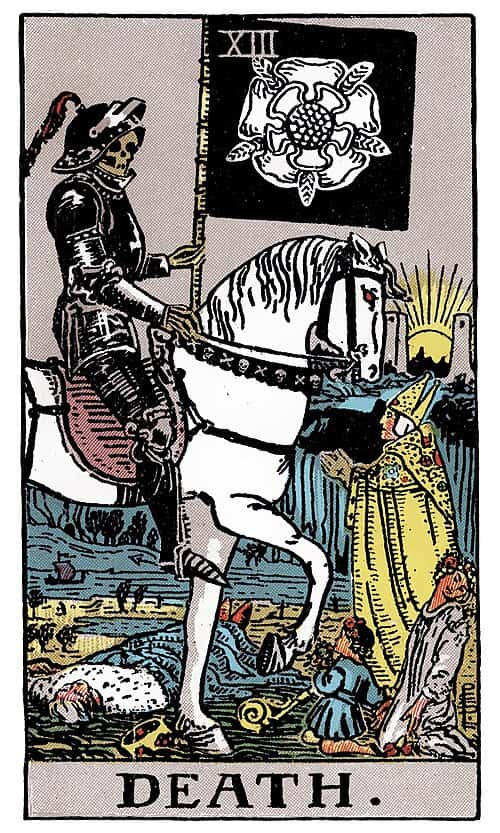
XIII · Major Arcana
Death
Endings, transformation, release, necessary change, making space for new
Go deeper with Death
The meanings below are a starting point. Bring what's actually on your mind and reflect on it here — what comes back is a question to sit with, never a forecast.
Reflection Room
Death · upright
Write and save if you'd rather sit with it alone. Nothing is sent.
Death Upright Meaning
Death invites you into the difficult and essential territory of real endings. This is almost never literal — Death in tarot means the completion of something, the necessity of closing a chapter so another can open. This might be a relationship that has run its course, a job or identity you've outgrown, a belief that no longer serves you, a version of yourself that is ready to shed. The card meets you in the grief of that. But it also holds something else: the recognition that not all ends are failures. Some are completions. Some are necessary. Some are merciful. The courage this card asks for is the courage to acknowledge that something is over — to stop resisting what is already true, to grieve it fully, and to let that clearing make space for what is trying to be born.
This card as a mirror: what has already ended that you haven't fully allowed yourself to acknowledge is over — and what might become possible if you gave yourself permission to grieve it and release it?
Death Reversed Meaning
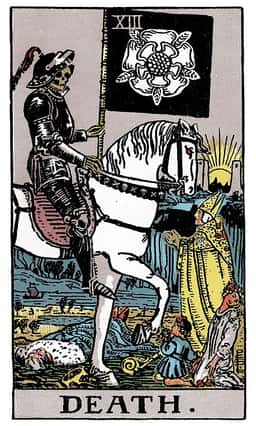
Death reversed often points to situations where something has ended but you haven't let it yet. You're trying to resurrect the dead, to keep a relationship functioning past its natural span, to hold onto an identity that no longer fits. It can suggest the fear that if this ends, nothing new will come — a terror of the void. It can also point to the opposite: a loss so sudden, a change so catastrophic, that you're in shock and can't yet process that something has ended. The reversal can mean you're experiencing the physical symptoms of grief without understanding that grief is what's happening.
This card as a mirror: what are you refusing to let end, and what are you afraid will happen if you finally let go?
The Death in Love & Relationships
Upright
Death here asks whether you're honoring something that has genuinely ended — a relationship that stopped meeting you, a version of partnership that no longer fits, a dynamic that has run its natural course. The card isn't asking you to leave; it's asking you to notice what's already gone and what grief you're carrying around that loss.
Reversed
You may be trying to resuscitate something that has already died, or you're in the shock of a sudden ending and can't yet name it as an ending. This reversal often shows up when people stay in relationships past their expiration date, afraid that release means emptiness, or when a loss is so fresh that your body knows before your mind does.
The Death in Work & Career
Upright
A job, role, or professional identity may have completed its arc. This card asks you to sit with the recognition that you've outgrown it — not as failure, but as a genuine ending that might be opening space for something new. The work here is in allowing yourself to grieve the loss of that structure or identity, rather than pretending it still fits.
Reversed
You might be holding onto a position, title, or way of working long past the point where it serves you, or you're in denial about a change that's already happened. Reversed Death in career can also show up as burnout you haven't named yet, or a layoff so sudden that you're moving through the motions without processing that this chapter has closed.
Death: Yes or No?
Leans toward no — and the better question underneath is: what needs to end before you can move toward what you actually want?
Yes-or-no readings are the one place tarot pretends to be a fortune teller. We answer the question, then hand you the better one underneath it — that's the part worth your time.
Questions to ask when you draw Death
- What have you already decided is over, but are still acting as though it's alive?
- If you allowed this ending to be final, what would you have to grieve, and what might become possible on the other side of that grief?
- What are you afraid will happen if you stop trying to fix or preserve this thing?
Guides that talk about Death
Cards near Death
Beside it on the Fool's Journey
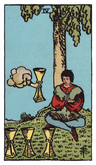
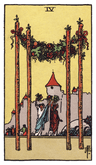
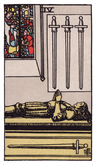
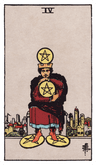
Shares its number: the Fours
Shares its themes
Death Symbolism
Interpretive Traditions
Different schools of tarot bring different lenses to the Death. These are perspectives, not contradictions.
Rider-Waite-Smith
Waite was explicit: this card is almost never literal death. It represents the transformation that comes from letting something genuinely end. The white horse, the rising sun, and the peaceful figures all suggest that this is a passage, not a punishment. Death becomes a teacher about impermanence and renewal.
Thoth
Crowley associated Death with Scorpio and emphasized the alchemical transformation: what dies in one form is reborn in another. Death is the ultimate transformer, the force that tears down fixed forms so that evolution can occur. It is terrible and necessary.
Modern Intuitive
Contemporary readers emphasise both the literal and the metaphorical: yes, this is about psychological death and transformation, but real losses and real grief are also valid. This card invites us to honor both the necessity of endings and the realness of the pain they bring.
Campbell parallel
The Supreme Ordeal — the death and rebirth
In your life
This card appears when something has actually ended — a relationship, a chapter, a version of yourself — and you're still caught in the resistance to it, as if pushing hard enough could bring it back. It invites a different relationship with endings: the recognition that some things are complete, that completion is not the same as failure, and that the only way through the grief is through. There is a child in the Death card holding flowers without fear, understanding something the fallen king did not: that the ending is part of the story, not the cancellation of it. And behind it all, the sun is rising. There is always a dawn.
Death Keywords & Themes
The Death tarot card is associated with the following themes and keywords across upright and reversed positions: endings, necessary change, letting go, grief, completion, transformation through release, resistance, stagnation, refusing necessary change, terror of the void, unprocessed loss, holding on too long. Its elemental correspondence is Water. Astrologically it is linked to Scorpio. Its planetary ruler is Pluto.
Whether you drew the Death in a daily pull, a weekly spread, or a year-ahead reading, its core invitation is the same: to look honestly at what this card is reflecting in your own life. Tarot Digest uses the Death — and all 78 cards — as mirrors for self-inquiry, not prediction.
Recommended Decks & Books
Whether you're just starting with tarot or deepening a long practice, these are the decks and books most worth your time.
- 🃏
The Original Rider Waite Smith Tarot — A.E. Waite & Pamela Coleman Smith
The deck that defined modern tarot. First published in 1909, the RWS introduced illustrated pip cards for all 78 positions — a breakthrough that made tarot accessible to everyone. Every major deck since is either an homage or a reaction to it.
- 📖
Seventy-Eight Degrees of Wisdom — Rachel Pollack
The definitive companion to tarot, first published in 1980 and still the best single-volume guide. Pollack reads the cards as a living psychological system — the Major Arcana as a map of consciousness, the Minor as the terrain of daily life.
- 📖
The Creative Tarot — Jessa Crispin
A guide to using tarot as a tool for creative practice rather than divination — written for writers, artists, and makers. Crispin brings a sharp literary sensibility and treats the cards as a language for thinking about creative process.
- 🃏
Modern Witch Tarot Deck — Lisa Sterle
The RWS structure reimagined with diverse, contemporary figures in modern settings. Every symbol from the original is preserved (the Fool still stands at the cliff edge, the High Priestess still flanked by pillars), but the world looks like ours.
Links above may earn a small commission at no cost to you — affiliate code tarotdigest-20. Disclosure