
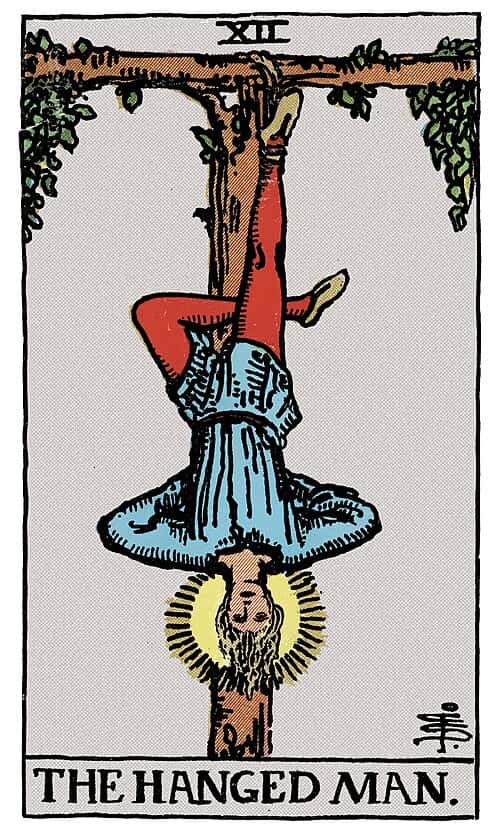
XII · Major Arcana
The Hanged Man
Suspension, pause, sacrifice, new perspective, surrender
Go deeper with The Hanged Man
The meanings below are a starting point. Bring what's actually on your mind and reflect on it here — what comes back is a question to sit with, never a forecast.
Reflection Room
The Hanged Man · upright
Write and save if you'd rather sit with it alone. Nothing is sent.
The Hanged Man Upright Meaning
The Hanged Man invites you into a paradoxical place: the power that comes from stopping. This is not defeat or paralysis, but the deliberate choice to pause when the ordinary path is no longer working. This card asks: what are you willing to release to see differently? What would happen if you stopped struggling against what you cannot change and instead let yourself be held in the discomfort? When you hang suspended — when you surrender the need to move, to achieve, to be in control — a new perspective becomes available. You see what was invisible when you were upright and rushing. The Hanged Man wears an expression of peace. This suggests that surrender, when it is chosen, brings a strange kind of relief.
This card as a mirror: where in your life are you forcing movement when stillness might serve you better — and what might become visible if you stopped trying to solve this, at least for a while?
The Hanged Man Reversed Meaning
The Hanged Man reversed often points to situations where you're stuck but unable or unwilling to surrender into the stuckness. It can suggest impatience — the sense that you should be past this, that the pause has gone on too long, that you're wasting time. It can also point to the opposite problem: a sacrifice that doesn't serve you, a surrender that has become entanglement, a pause that has hardened into paralysis. The reversal can mean you've lost faith that anything valuable comes from stopping, or that you've given up things for unclear reasons and now feel resentful rather than peaceful.
This card as a mirror: are you in a genuine pause that's transforming you — or are you stuck, unable to move, unable to surrender, unable to let this time have meaning?
The Hanged Man in Love & Relationships
Upright
This card asks whether you're trying to fix something that needs time instead. A relationship under strain often demands not more effort but a shift in what you're attending to — stepping back from the impulse to solve, persuade, or prove yourself, and instead staying present with what is. What becomes visible when you stop performing or strategizing?
Reversed
You may be caught between two uncomfortable places: unable to accept that this relationship needs a real pause, or else surrendered into a dynamic that no longer feels like a choice. The reversal asks whether you're mistaking endurance for commitment, or whether you've given up something essential and now feel only the loss of it. What would it mean to actively decide, rather than simply wait?
The Hanged Man in Work & Career
Upright
The card invites you to notice where you're pushing against resistance instead of pausing to let the situation reorganize itself. Sometimes a project stalls not because you're failing but because the ordinary approach has hit its limit, and the next move requires you to stop, listen, and see from a different angle. What would change if you gave this one thing permission to be still for a while?
Reversed
You may be spinning in frustration — aware something isn't working but unable to rest into that awareness long enough for clarity to arrive. Or you've made a sacrifice (time, ambition, a path you wanted) that now feels hollow, and you're resenting the pause instead of finding its value. The reversal asks: are you stuck waiting for permission to move, or stuck refusing to accept what the waiting might teach you?
The Hanged Man: Yes or No?
Leans toward not yet — and the better question underneath is whether rushing toward yes would bypass something important you need to see.
Yes-or-no readings are the one place tarot pretends to be a fortune teller. We answer the question, then hand you the better one underneath it — that's the part worth your time.
Questions to ask when you draw The Hanged Man
- What are you trying to force forward that might actually need to sit still for a while?
- If you stopped trying to solve this, what would you notice that you can't see right now?
- Where is surrender a real choice for you, and where does it feel like resignation?
Cards near The Hanged Man
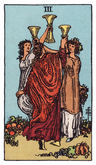
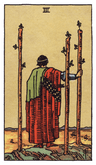
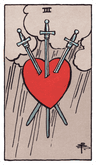
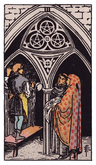
Shares its number: the Threes
Shares its themes
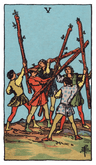
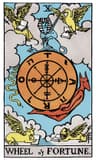
The Hanged Man Symbolism
Interpretive Traditions
Different schools of tarot bring different lenses to The Hanged Man. These are perspectives, not contradictions.
Rider-Waite-Smith
Waite deliberately positioned The Hanged Man as a moment of transformation rather than punishment. The figure has chosen this. By connecting the card to the myth of Odin hanging from the World Tree to gain wisdom, Waite placed sacrifice in a spiritual context: the giving up of one perspective to gain a deeper understanding.
Thoth
Crowley's Hanged Man emphasises the alchemical process: dissolution before reintegration, the breaking down of fixed ideas to allow new consciousness to form. The association with Neptune brings the watery, boundary-dissolving quality that allows old structures to soften.
Modern Intuitive
Contemporary readers often frame The Hanged Man as permission to pause in a culture obsessed with productivity. This card becomes radically countercultural: an invitation to stop, to let things not progress, to do nothing and trust that something valuable is happening beneath the surface.
Campbell parallel
The Supreme Ordeal — the willing sacrifice
In your life
This card appears when you're caught in a place where your usual strategies aren't working — where pushing harder only digs you deeper. It invites a radical pause: not defeat, but the kind of surrender that creates space for something new to emerge. Sometimes the only way forward is to stop trying to go forward. Sometimes the most powerful action is to hang suspended, to let the world turn around you, and to wait for the new perspective that comes from being still enough to truly see.
The Hanged Man Keywords & Themes
The Hanged Man tarot card is associated with the following themes and keywords across upright and reversed positions: surrender, pause, release, new perspective, accepting limitation, sacred waiting, stuckness, impatience, unwilling paralysis, meaningless sacrifice, resisting the pause, unclear surrender. Its elemental correspondence is Water. Its planetary ruler is Neptune.
Whether you drew The Hanged Man in a daily pull, a weekly spread, or a year-ahead reading, its core invitation is the same: to look honestly at what this card is reflecting in your own life. Tarot Digest uses The Hanged Man — and all 78 cards — as mirrors for self-inquiry, not prediction.
Recommended Decks & Books
Whether you're just starting with tarot or deepening a long practice, these are the decks and books most worth your time.
- 🃏
The Original Rider Waite Smith Tarot — A.E. Waite & Pamela Coleman Smith
The deck that defined modern tarot. First published in 1909, the RWS introduced illustrated pip cards for all 78 positions — a breakthrough that made tarot accessible to everyone. Every major deck since is either an homage or a reaction to it.
- 📖
Seventy-Eight Degrees of Wisdom — Rachel Pollack
The definitive companion to tarot, first published in 1980 and still the best single-volume guide. Pollack reads the cards as a living psychological system — the Major Arcana as a map of consciousness, the Minor as the terrain of daily life.
- 📖
The Creative Tarot — Jessa Crispin
A guide to using tarot as a tool for creative practice rather than divination — written for writers, artists, and makers. Crispin brings a sharp literary sensibility and treats the cards as a language for thinking about creative process.
- 🃏
Modern Witch Tarot Deck — Lisa Sterle
The RWS structure reimagined with diverse, contemporary figures in modern settings. Every symbol from the original is preserved (the Fool still stands at the cliff edge, the High Priestess still flanked by pillars), but the world looks like ours.
Links above may earn a small commission at no cost to you — affiliate code tarotdigest-20. Disclosure