
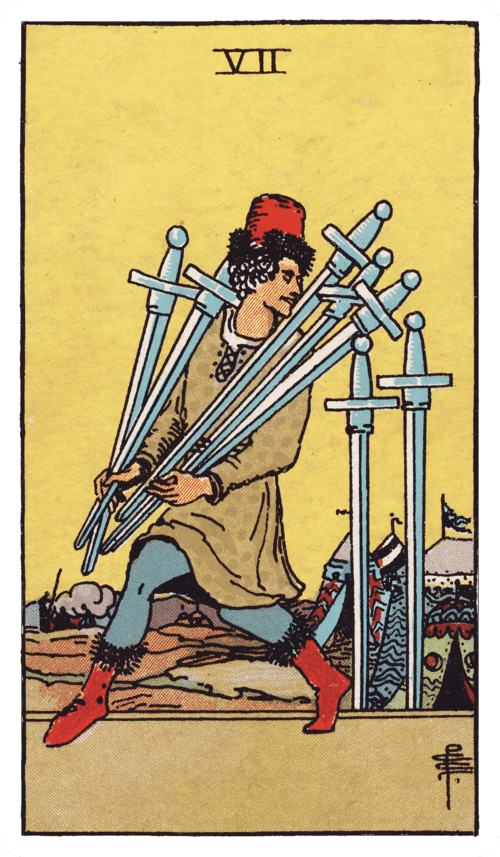
Swords · Minor Arcana
Seven of Swords
Strategy and cunning, a partial truth, intellectual evasion, talking around things
Go deeper with Seven of Swords
The meanings below are a starting point. Bring what's actually on your mind and reflect on it here — what comes back is a question to sit with, never a forecast.
Reflection Room
Seven of Swords · upright
Write and save if you'd rather sit with it alone. Nothing is sent.
Seven of Swords Upright Meaning
The Seven of Swords invites you to look at how you're using your mind right now. Are you strategising in ways that serve the situation, or are you being clever about things that need directness? This card can point to evasion — the truth you're not saying, the perspective you're spinning to your advantage, the way you're justifying something you know doesn't sit right. The Swords suit is about clarity, and this card names the ways we use intelligence to avoid clarity. It's not harsh; it's honest. What if you said the simpler truth instead?
This card as a mirror: where are you being intellectually dishonest? What truth are you avoiding by being clever?
Seven of Swords Reversed Meaning
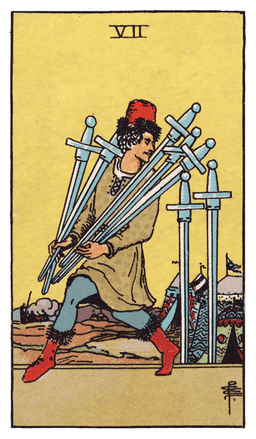
The Seven of Swords reversed often signals that the evasion is becoming unsustainable — the truth is beginning to surface, or you're beginning to tire of the pretence. Sometimes this card reversed points to you being caught in an evasion that isn't yours, or seeing through someone else's cleverness. The invitation is simple: what would happen if you just said what was actually true?
This card as a mirror: what truth is trying to break through? What would happen if you stopped strategising and just told the truth?
The Seven of Swords in Love & Relationships
Upright
You might be managing the narrative of your relationship rather than being straight about what you want or what's troubling you. The Seven of Swords asks: are you explaining away a problem, softening a boundary, or framing something in a way that lets you off the hook? Directness feels riskier than strategy, but strategy costs you clarity with the person closest to you.
Reversed
The pretence is wearing thin — either you're tired of keeping up the story, or your partner is starting to see through it. This is often where real conversation becomes possible, even if it feels uncomfortable. What would shift if you stopped managing how you're perceived and just said what's actually true?
The Seven of Swords in Work & Career
Upright
You're using your intelligence to sidestep something — maybe a conversation you need to have, a limitation you're disguising as strategy, or a choice you're justifying rather than owning. This works until it doesn't. The card asks whether your approach is serving the actual work or just protecting you from the awkwardness of being direct.
Reversed
The cover story is unraveling, or you're running out of energy to maintain it. Colleagues may be catching on; you may be catching on. This pressure point is where you get to choose: keep defending the spin, or step into what's actually happening and deal with it.
Seven of Swords: Yes or No?
Leans toward no — and the better question underneath is: what are you avoiding saying, and what would happen if you said it anyway?
Yes-or-no readings are the one place tarot pretends to be a fortune teller. We answer the question, then hand you the better one underneath it — that's the part worth your time.
Questions to ask when you draw Seven of Swords
- What truth are you currently explaining away or softening, and what are you protecting by doing that?
- If you took strategy completely off the table, what would you actually say or do in this situation?
- What would it cost you to be direct, and what is it currently costing you not to be?
Cards near Seven of Swords
Next door in Swords
The other Sevens
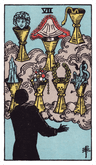
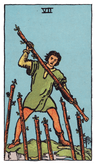
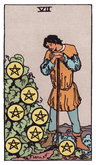
Shares its themes
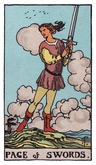
Seven of Swords Symbolism
Interpretive Traditions
Different schools of tarot bring different lenses to the Seven of Swords. These are perspectives, not contradictions.
Rider-Waite-Smith
Waite read the Seven of Swords as cunning and evasion — not evil, but dishonest. The card points to the gap between what's true and what's being said, and asks whether that gap serves anyone. Particularly relevant when intellectual gifts are being used to avoid responsibility.
Thoth
Crowley associated this card with Netzach in Air — the principle of strategy and the mind applied to getting what it wants without full engagement. The Seven is the thought that circles back on itself, justifying what it wants to justify.
Modern Intuitive
Contemporary readers often frame this card as an invitation to examine the stories you tell yourself and others — the narratives that let you feel okay about things you know aren't quite right. The card doesn't judge; it invites awareness.
Seven of Swords Keywords & Themes
The Seven of Swords tarot card is associated with the following themes and keywords across upright and reversed positions: strategy, cunning, evasion, half-truths, intellectual dishonesty, avoiding directness, truth revealed, honesty restored, directness, catching deception, moving beyond evasion. Its elemental correspondence is Air.
Whether you drew the Seven of Swords in a daily pull, a weekly spread, or a year-ahead reading, its core invitation is the same: to look honestly at what this card is reflecting in your own life. Tarot Digest uses the Seven of Swords — and all 78 cards — as mirrors for self-inquiry, not prediction.
Recommended Decks & Books
Whether you're just starting with tarot or deepening a long practice, these are the decks and books most worth your time.
- 🃏
The Original Rider Waite Smith Tarot — A.E. Waite & Pamela Coleman Smith
The deck that defined modern tarot. First published in 1909, the RWS introduced illustrated pip cards for all 78 positions — a breakthrough that made tarot accessible to everyone. Every major deck since is either an homage or a reaction to it.
- 📖
Seventy-Eight Degrees of Wisdom — Rachel Pollack
The definitive companion to tarot, first published in 1980 and still the best single-volume guide. Pollack reads the cards as a living psychological system — the Major Arcana as a map of consciousness, the Minor as the terrain of daily life.
- 📖
The Creative Tarot — Jessa Crispin
A guide to using tarot as a tool for creative practice rather than divination — written for writers, artists, and makers. Crispin brings a sharp literary sensibility and treats the cards as a language for thinking about creative process.
- 🃏
Modern Witch Tarot Deck — Lisa Sterle
The RWS structure reimagined with diverse, contemporary figures in modern settings. Every symbol from the original is preserved (the Fool still stands at the cliff edge, the High Priestess still flanked by pillars), but the world looks like ours.
Links above may earn a small commission at no cost to you — affiliate code tarotdigest-20. Disclosure