
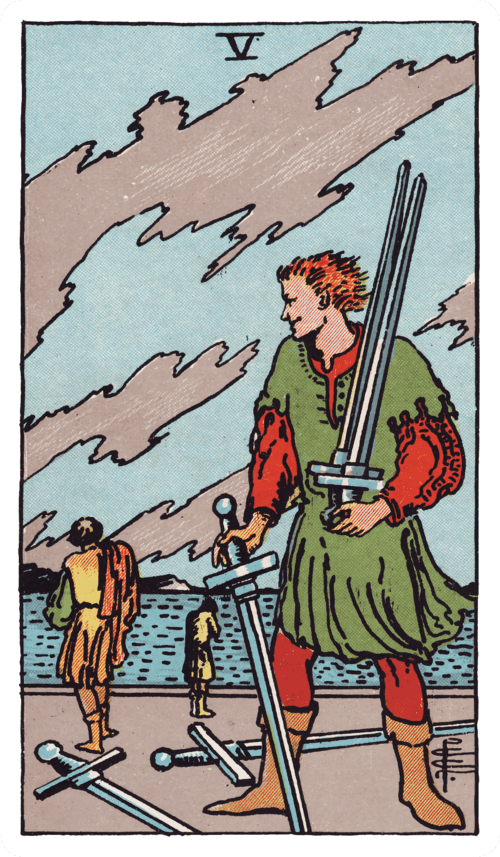
Swords · Minor Arcana
Five of Swords
Defeat, an argument won but something lost, a hollow victory
Go deeper with Five of Swords
The meanings below are a starting point. Bring what's actually on your mind and reflect on it here — what comes back is a question to sit with, never a forecast.
Reflection Room
Five of Swords · upright
Write and save if you'd rather sit with it alone. Nothing is sent.
Five of Swords Upright Meaning
The Five of Swords names the experience of losing — whether through direct conflict, a disagreement that has damaged something you valued, or the realisation that being right didn't make anything better. This card is honest about difficulty. Sometimes the mind's insistence on being correct costs more than the issue was worth. Sometimes you win the argument and lose the relationship. The invitation here is not to wallow but to see clearly: what was the actual cost of this? And what does victory look like if it leaves you hollow?
This card as a mirror: what have you won that didn't feel like winning? Where has being right cost you something deeper?
Five of Swords Reversed Meaning
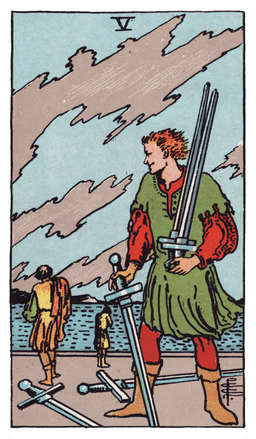
The Five of Swords reversed often marks the moment when you stop re-litigating what happened and start moving through it. The defeat is real; it doesn't disappear. But you're beginning to let go of the internal argument, the endless replay, the justification. Sometimes reversed, this card points to reconciliation — a moment where you can acknowledge what was actually true on both sides and begin to heal the rift.
This card as a mirror: are you beginning to accept this loss without making it mean something about you? What would it take to let this go?
The Five of Swords in Love & Relationships
Upright
This card asks you to look at what you've defended and at what cost. Did you win an argument while damaging trust, or hold a boundary so firmly that the relationship couldn't bend around it? The question isn't whether you were right — it's whether rightness mattered more than what you actually wanted from this person.
Reversed
You're moving past the need to prove your case, which opens a different kind of space. This doesn't mean pretending the hurt didn't happen, but rather seeing the other person's position without needing yours to be the only true one. Reconciliation, if it comes, starts here — with the internal argument finally quieting.
The Five of Swords in Work & Career
Upright
You may have won a negotiation, a disagreement, or a competitive moment, but notice what it cost you. Did you establish yourself as right while becoming harder to work with? Did you win a project or a promotion in a way that isolated you from your team? The Five of Swords asks: was the victory worth the cost to how you're seen or how you feel about the work?
Reversed
The difficult moment or loss is real, and you're not pretending otherwise. But you're moving past replaying it, past justifying your side to yourself. This is when you can actually learn from what happened instead of defending against it — when you're ready to see what went wrong without it meaning you failed.
Five of Swords: Yes or No?
Leans toward no — and the better question underneath is: what are you actually trying to win here, and would winning it feel like success?
Yes-or-no readings are the one place tarot pretends to be a fortune teller. We answer the question, then hand you the better one underneath it — that's the part worth your time.
Questions to ask when you draw Five of Swords
- What did you have before this conflict that you don't have now, and was being right worth that trade?
- If you stopped needing to prove your point, what would you want to do or say instead?
- What would it look like to move forward without first getting the other person to admit you were right?
Cards near Five of Swords
Next door in Swords
The other Fives
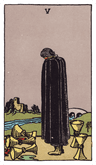
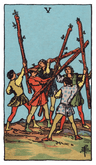
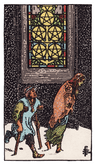
Shares its themes
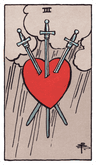
Five of Swords Symbolism
Interpretive Traditions
Different schools of tarot bring different lenses to the Five of Swords. These are perspectives, not contradictions.
Rider-Waite-Smith
Waite read the Five of Swords as defeat and loss, with particular emphasis on the futility of continued argument when the real damage has already been done. The point isn't to assign blame; it's to recognise when a conflict has stopped being about resolution and become about winning.
Thoth
Crowley associated this card with Geburah in Air — the principle of conflict's true cost, stripped of heroics. This is destruction in the name of clarity, and the realisation that not all clarity is worth the price.
Modern Intuitive
Contemporary readers often use this card to validate the experience of being in an unwinnable situation — where backing down feels like submission and pushing forward feels destructive. The card says: sometimes there is no good choice. Grieve what's lost and move on.
Five of Swords Keywords & Themes
The Five of Swords tarot card is associated with the following themes and keywords across upright and reversed positions: defeat, loss, pyrrhic victory, the cost of winning, moral compromise, hard lessons, acceptance of loss, moving forward, reconciliation possible, releasing resentment, integration of defeat. Its elemental correspondence is Air.
Whether you drew the Five of Swords in a daily pull, a weekly spread, or a year-ahead reading, its core invitation is the same: to look honestly at what this card is reflecting in your own life. Tarot Digest uses the Five of Swords — and all 78 cards — as mirrors for self-inquiry, not prediction.
Recommended Decks & Books
Whether you're just starting with tarot or deepening a long practice, these are the decks and books most worth your time.
- 🃏
The Original Rider Waite Smith Tarot — A.E. Waite & Pamela Coleman Smith
The deck that defined modern tarot. First published in 1909, the RWS introduced illustrated pip cards for all 78 positions — a breakthrough that made tarot accessible to everyone. Every major deck since is either an homage or a reaction to it.
- 📖
Seventy-Eight Degrees of Wisdom — Rachel Pollack
The definitive companion to tarot, first published in 1980 and still the best single-volume guide. Pollack reads the cards as a living psychological system — the Major Arcana as a map of consciousness, the Minor as the terrain of daily life.
- 📖
The Creative Tarot — Jessa Crispin
A guide to using tarot as a tool for creative practice rather than divination — written for writers, artists, and makers. Crispin brings a sharp literary sensibility and treats the cards as a language for thinking about creative process.
- 🃏
Modern Witch Tarot Deck — Lisa Sterle
The RWS structure reimagined with diverse, contemporary figures in modern settings. Every symbol from the original is preserved (the Fool still stands at the cliff edge, the High Priestess still flanked by pillars), but the world looks like ours.
Links above may earn a small commission at no cost to you — affiliate code tarotdigest-20. Disclosure