
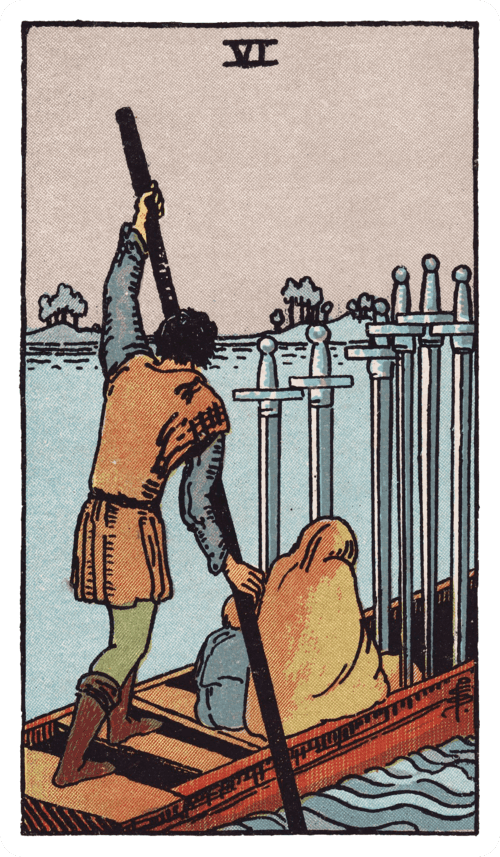
Swords · Minor Arcana
Six of Swords
A passage through difficulty, moving to calmer waters, safe transition
Go deeper with Six of Swords
The meanings below are a starting point. Bring what's actually on your mind and reflect on it here — what comes back is a question to sit with, never a forecast.
Reflection Room
Six of Swords · upright
Write and save if you'd rather sit with it alone. Nothing is sent.
Six of Swords Upright Meaning
The Six of Swords invites you into the experience of moving forward — perhaps leaving behind a difficult situation, a relationship, or a way of thinking that no longer serves you. This card is tender about transition. It suggests the journey itself is protected, even if where you're leaving from was turbulent. You're not running in panic; you're choosing a direction. The waters ahead are calmer. The mind can begin to settle. This card says: you can trust this movement. You have chosen the right direction.
This card as a mirror: what are you leaving behind? What clarity or safety are you moving toward?
Six of Swords Reversed Meaning
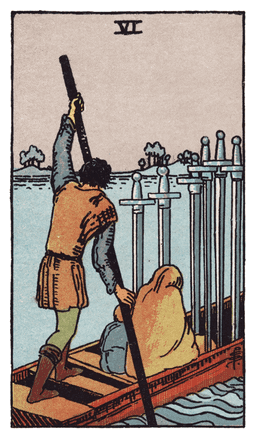
The Six of Swords reversed often signals that the journey hasn't begun yet, or that you're caught between wanting to leave and fearing what comes next. Sometimes this card reversed points to the difficulty of letting go of what's familiar, even when it's painful. The waters aren't moving because you're still anchored. The invitation is gentle: what's keeping you from moving? Is it safety you're worried about, or the loss of what you know?
This card as a mirror: what's preventing you from making the transition you know you need to make? What are you afraid of leaving?
The Six of Swords in Love & Relationships
Upright
This card asks what you're moving toward in this relationship, not just what you're leaving. If you're in a partnership, notice whether you're both rowing in the same direction — toward shared calm, or at least toward understanding. If you're single or leaving, the card invites you to recognize that a deliberate choice, even a hard one, is different from flight.
Reversed
You might be stuck between wanting the relationship to change and fearing what honesty or distance would actually cost. The anchor here isn't always the relationship itself — it's the weight of familiarity, or the story you've told yourself about what you owe. What would it mean to stop waiting for permission to move?
The Six of Swords in Work & Career
Upright
A transition is underway or ready to begin — a job change, a shift in how you work, or leaving behind a role that no longer fits. This card suggests the move itself is steady, not chaotic. What matters now is checking whether you're clear on what you're moving *toward*, not just what you're leaving *from*.
Reversed
You've recognized you need a change, but something keeps you from taking it: uncertainty about your next move, worry about stability, or the difficulty of releasing a familiar (even if unsatisfying) role. The card asks you to name what's actually holding you in place — fear of the unknown, or fear of losing something you value, even if it doesn't serve you anymore?
Six of Swords: Yes or No?
Leans toward yes — and the better question underneath is whether you're ready to move, or just tired of where you are. Movement for its own sake isn't the same as a clear direction.
Yes-or-no readings are the one place tarot pretends to be a fortune teller. We answer the question, then hand you the better one underneath it — that's the part worth your time.
Questions to ask when you draw Six of Swords
- What are you genuinely moving toward, and what are you just trying to escape?
- If the external situation didn't change, what would have to shift inside you to feel like you've moved forward?
- What part of your current situation would you miss, even if you left it?
Cards near Six of Swords
Next door in Swords
The other Sixs
Shares its themes
Six of Swords Symbolism
Interpretive Traditions
Different schools of tarot bring different lenses to the Six of Swords. These are perspectives, not contradictions.
Rider-Waite-Smith
Waite emphasised the Six of Swords as a card of safe passage and necessary departure. The journey isn't instantaneous; it unfolds. But the direction is right and the passage is protected. This card honours the difficulty of leaving while affirming the rightness of it.
Thoth
Crowley associated this card with the principle of transition in Air — the mind in motion toward clarity, carried on the breath of understanding. The swords are laid down because intellectual struggle is being transcended, not because the mind stops working.
Modern Intuitive
Contemporary readers often frame this card as permission to move on — from a relationship, a job, a belief system, or a version of yourself that no longer fits. The card validates both the necessity and the difficulty of leaving.
Six of Swords Keywords & Themes
The Six of Swords tarot card is associated with the following themes and keywords across upright and reversed positions: safe passage, transition, moving forward, leaving behind, journey to clarity, calm approaching, delayed transition, resistance to change, fear of the journey, unfinished business, lingering attachment. Its elemental correspondence is Air.
Whether you drew the Six of Swords in a daily pull, a weekly spread, or a year-ahead reading, its core invitation is the same: to look honestly at what this card is reflecting in your own life. Tarot Digest uses the Six of Swords — and all 78 cards — as mirrors for self-inquiry, not prediction.
Recommended Decks & Books
Whether you're just starting with tarot or deepening a long practice, these are the decks and books most worth your time.
- 🃏
The Original Rider Waite Smith Tarot — A.E. Waite & Pamela Coleman Smith
The deck that defined modern tarot. First published in 1909, the RWS introduced illustrated pip cards for all 78 positions — a breakthrough that made tarot accessible to everyone. Every major deck since is either an homage or a reaction to it.
- 📖
Seventy-Eight Degrees of Wisdom — Rachel Pollack
The definitive companion to tarot, first published in 1980 and still the best single-volume guide. Pollack reads the cards as a living psychological system — the Major Arcana as a map of consciousness, the Minor as the terrain of daily life.
- 📖
The Creative Tarot — Jessa Crispin
A guide to using tarot as a tool for creative practice rather than divination — written for writers, artists, and makers. Crispin brings a sharp literary sensibility and treats the cards as a language for thinking about creative process.
- 🃏
Modern Witch Tarot Deck — Lisa Sterle
The RWS structure reimagined with diverse, contemporary figures in modern settings. Every symbol from the original is preserved (the Fool still stands at the cliff edge, the High Priestess still flanked by pillars), but the world looks like ours.
Links above may earn a small commission at no cost to you — affiliate code tarotdigest-20. Disclosure