
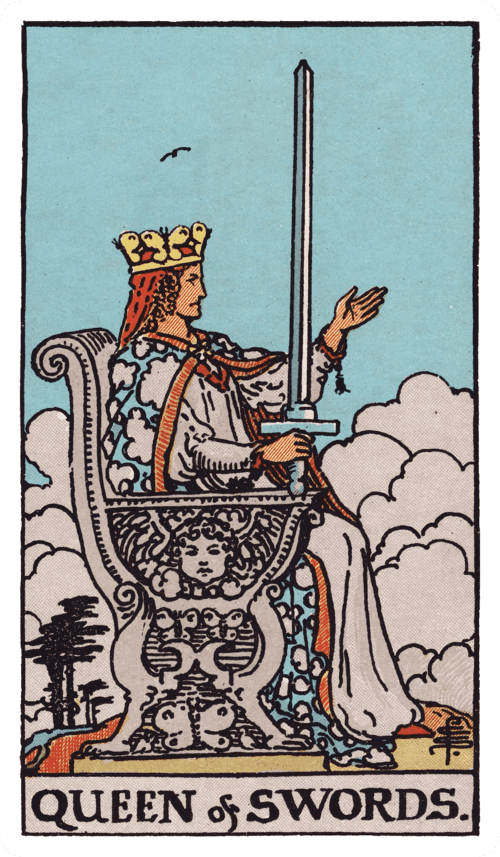
Swords · Minor Arcana
Queen of Swords
Clear-eyed wisdom, honest perception, independent thought
Also known as
Thoth: Queen of Swords — Consistent across traditions. Crowley's Queen of Swords emphasises intense perception and the power to cut through illusion — well aligned with the RWS reading.
Go deeper with Queen of Swords
The meanings below are a starting point. Bring what's actually on your mind and reflect on it here — what comes back is a question to sit with, never a forecast.
Reflection Room
Queen of Swords · upright
Write and save if you'd rather sit with it alone. Nothing is sent.
Queen of Swords Upright Meaning
The Queen of Swords has lived through enough to see clearly — and she has chosen honesty over comfort, even when that choice was costly. Her intelligence is not cold; it is earned. She knows the difference between a feeling and a fact, between what she wishes were true and what actually is. When this card appears it often invites you to bring that same quality of clear, compassionate honesty to something in your life — especially something you've been seeing through the lens of what you want it to be.
Where in your life right now would honest, unsparing clarity — applied with compassion toward yourself and others — change something important?
Queen of Swords Reversed Meaning
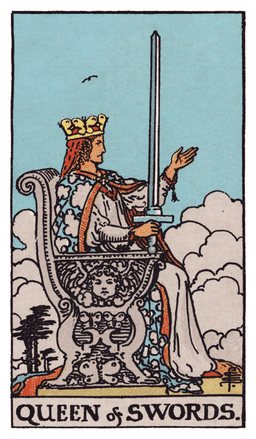
The Queen of Swords reversed often points to pain that has calcified into detachment — a mind that has learned to protect itself from feeling by becoming analytical about everything, including things that deserve to be felt. The intelligence is real, but it has been turned into a wall. There can also be an edge of cruelty here: the sharp tongue that doesn't know when to stop, the criticism that has forgotten compassion.
Is there somewhere in your life where you've been using your intelligence to keep feeling at a distance — and what might you need to feel if you lowered that particular defence?
The Queen of Swords in Love & Relationships
Upright
This card asks whether you're seeing your relationship clearly or through the filter of what you want it to be. The Queen of Swords suggests bringing honesty into the spaces where you've been softer: the patterns you've overlooked, the conversations you've postponed, the small resentments you've rationalized away. Clarity here isn't cruel; it's the kindness of speaking what's true.
Reversed
You may have retreated into analysis as a way to avoid the vulnerability that intimacy requires. Ask yourself whether you've been using logic to explain away hurt, or whether you've let criticism become a substitute for the harder work of being honest about what you actually feel. The question is whether your defenses are protecting you or isolating you.
The Queen of Swords in Work & Career
Upright
Look at where you've been avoiding difficult conversations or honest feedback because they felt uncomfortable. The Queen of Swords asks you to notice the situations where you know what needs to be said but haven't said it yet. Bringing this kind of clarity to your work often costs something in the short term, but it costs far more to keep silent.
Reversed
You may have become so focused on being right, or on the logic of a situation, that you've stopped listening to the people around you. This card suggests examining whether your critique has become disconnected from compassion. The question worth sitting with is whether you're solving problems or just sharpening your arguments.
Queen of Swords: Yes or No?
Leans toward yes — and the better question underneath is whether you're prepared for the honesty that comes with it, and whether you're willing to act on what you see.
Yes-or-no readings are the one place tarot pretends to be a fortune teller. We answer the question, then hand you the better one underneath it — that's the part worth your time.
Questions to ask when you draw Queen of Swords
- What have you been seeing clearly but choosing not to name?
- Where in your life have you let intelligence become a wall instead of a tool?
- If you brought complete honesty to one situation right now, what would change?
Guides that talk about Queen of Swords
Cards near Queen of Swords
Next door in Swords
The other Queens
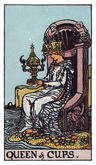
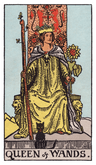
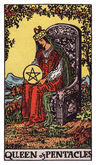
Shares its themes
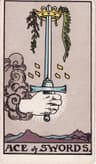
Queen of Swords Symbolism
Interpretive Traditions
Different schools of tarot bring different lenses to the Queen of Swords. These are perspectives, not contradictions.
Rider-Waite-Smith
Waite's Queen of Swords is sometimes described as a widow — someone who has experienced loss and emerged with a quality of perception that can only come from having faced what is real. She is associated with sorrow transformed into wisdom, grief converted into the capacity for clear seeing.
Thoth
Crowley's Queen of Swords is associated with intense perception and the dissolving of illusion. In the Thoth tradition she is the most purely intellectual of the Queens — water of air — capable of combining emotional intelligence with razor-sharp analysis in a way the Knights and Pages cannot.
Modern Intuitive
Contemporary readers often experience the Queen of Swords as one of the most complex and misunderstood cards in the deck — frequently read as cold when she is actually deeply feeling, just highly disciplined about what she does with those feelings. She invites the question of how much wisdom you've allowed your own difficult experiences to give you.
Queen of Swords Keywords & Themes
The Queen of Swords tarot card is associated with the following themes and keywords across upright and reversed positions: clear perception, hard-won wisdom, honest communication, independence, seeing without illusion, emotional coldness, bitterness, intellect as armour, cutting criticism, isolation through independence. Its elemental correspondence is Air. Astrologically it is linked to Libra.
Whether you drew the Queen of Swords in a daily pull, a weekly spread, or a year-ahead reading, its core invitation is the same: to look honestly at what this card is reflecting in your own life. Tarot Digest uses the Queen of Swords — and all 78 cards — as mirrors for self-inquiry, not prediction.
Recommended Decks & Books
Whether you're just starting with tarot or deepening a long practice, these are the decks and books most worth your time.
- 🃏
The Original Rider Waite Smith Tarot — A.E. Waite & Pamela Coleman Smith
The deck that defined modern tarot. First published in 1909, the RWS introduced illustrated pip cards for all 78 positions — a breakthrough that made tarot accessible to everyone. Every major deck since is either an homage or a reaction to it.
- 📖
Seventy-Eight Degrees of Wisdom — Rachel Pollack
The definitive companion to tarot, first published in 1980 and still the best single-volume guide. Pollack reads the cards as a living psychological system — the Major Arcana as a map of consciousness, the Minor as the terrain of daily life.
- 📖
The Creative Tarot — Jessa Crispin
A guide to using tarot as a tool for creative practice rather than divination — written for writers, artists, and makers. Crispin brings a sharp literary sensibility and treats the cards as a language for thinking about creative process.
- 🃏
Modern Witch Tarot Deck — Lisa Sterle
The RWS structure reimagined with diverse, contemporary figures in modern settings. Every symbol from the original is preserved (the Fool still stands at the cliff edge, the High Priestess still flanked by pillars), but the world looks like ours.
Links above may earn a small commission at no cost to you — affiliate code tarotdigest-20. Disclosure