
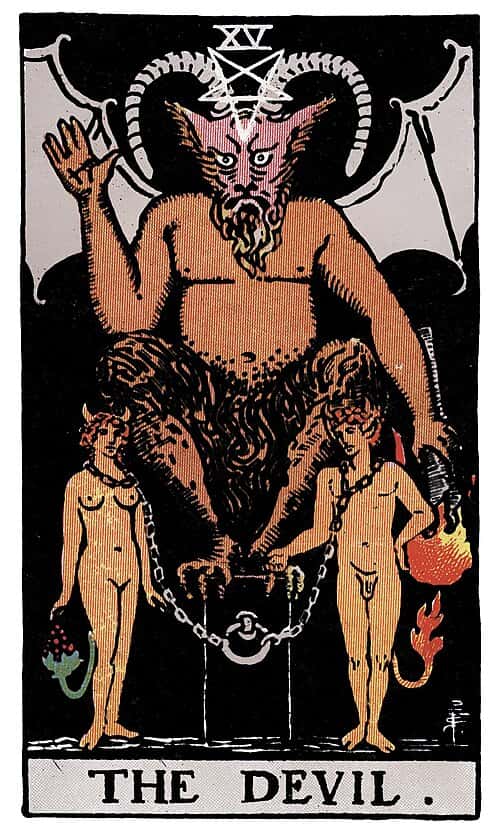
XV · Major Arcana
The Devil
Bondage, shadow self, attachment, denial of freedom
Go deeper with The Devil
The meanings below are a starting point. Bring what's actually on your mind and reflect on it here — what comes back is a question to sit with, never a forecast.
Reflection Room
The Devil · upright
Write and save if you'd rather sit with it alone. Nothing is sent.
The Devil Upright Meaning
This card invites you to look closely at where you feel trapped — or where you've stopped believing you could leave. The Devil's great power is not that it forces you to stay, but that it makes captivity feel necessary. You might notice patterns of compulsion, addiction, codependence, or the way a story you once accepted has hardened into an identity. Sometimes the shadow self that the Devil represents is not something imposed but something you've chosen not to see.
This card as a mirror: where in your life are you staying in a situation, pattern, or story that you could actually walk away from — and what would it cost you to admit that?
The Devil Reversed Meaning
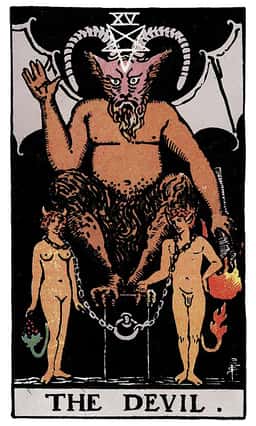
The Devil reversed often signals a moment of clarity — the sudden or gradual recognition that a chain you thought was permanent is actually quite loose. You might be questioning a story you've carried, naming a pattern you're ready to release, or reclaiming a part of yourself you'd exiled. The reversal asks: what happens when you actually look at what you've been accepting as inevitable?
This card as a mirror: what belief or pattern are you starting to see as optional rather than fixed — and what becomes possible if you don't fight to hold onto it?
The Devil in Love & Relationships
Upright
You might notice a dynamic where you've stopped believing you could leave, or where you're drawn to cycles that feel familiar even when they hurt. The question isn't whether the other person is holding you there — it's whether you've accepted a story about what you deserve or what love requires that keeps you from walking away.
Reversed
You're beginning to see a pattern or belief about your relationship as optional rather than inevitable. This might mean naming a dynamic you've tolerated, questioning a narrative you've carried about what you owe, or recognizing that a choice you thought was locked in place actually isn't.
The Devil in Work & Career
Upright
You might be staying in a role, industry, or working arrangement because you've stopped believing you could leave, or because the discomfort has become so familiar it reads as necessary. Look at what story you're telling yourself about your options — and whether that story is actually true.
Reversed
You're starting to question a belief you've held about what's possible for you professionally. You might be naming a pattern you're ready to change, recognizing a constraint as self-imposed rather than real, or reclaiming ambition or a part of yourself you'd set aside.
The Devil: Yes or No?
Leans toward no — and the better question underneath is: what would it cost you to admit that this situation isn't as fixed as you've been treating it?
Yes-or-no readings are the one place tarot pretends to be a fortune teller. We answer the question, then hand you the better one underneath it — that's the part worth your time.
Questions to ask when you draw The Devil
- What belief about this situation have you stopped questioning because it felt too big or too risky to challenge?
- If you removed the story you're telling about why you can't leave or change something, what would actually be left?
- What part of yourself have you decided not to see in order to stay comfortable with the way things are?
Guides that talk about The Devil
Cards near The Devil
Beside it on the Fool's Journey
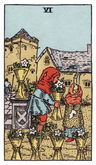
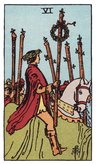
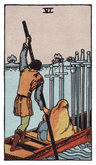
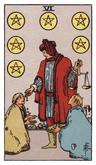
Shares its number: the Sixs
Shares its themes
The Devil Symbolism
Interpretive Traditions
Different schools of tarot bring different lenses to The Devil. These are perspectives, not contradictions.
Rider-Waite-Smith
Waite grounded the Devil card not in supernatural evil but in human psychology — the card is about self-imposed limitation, the chains we accept, the way we become complicit in our own binding. The loose chains are intentional: Waite wanted readers to understand this as a psychological condition, not a metaphysical one.
Thoth
Crowley's Devil is pure lust and will—not evil, but the drive toward material manifestation without moral consideration. The card emphasizes sexuality, appetite, and the shadow instincts. Frieda Harris's illustration leans into ecstasy and transgression as well as darkness — the shadow has its own energy.
Modern Intuitive
Contemporary readers often frame the Devil as the invitation to shadow work — the call to integrate the disowned parts of yourself rather than fight them. Rachel Pollack wrote of the Devil as 'the tyrant inside ourselves,' and modern practice treats it as a crucial card for psychological wholeness.
Campbell parallel
The Innermost Cave — encounter with the shadow
In your life
The Devil appears when something in your life has tightened — a pattern, a belief, a relationship — and you've stopped asking whether you actually want to stay. This card doesn't come to judge you. It comes to ask: what made you decide you had no choice?
The Devil Keywords & Themes
The Devil tarot card is associated with the following themes and keywords across upright and reversed positions: bondage, shadow self, self-deception, patterns we choose, what we deny about ourselves, liberation, clarity, breaking patterns, recognizing illusions, reclaiming choice. Its elemental correspondence is Earth. Astrologically it is linked to Capricorn. Its planetary ruler is Saturn.
Whether you drew The Devil in a daily pull, a weekly spread, or a year-ahead reading, its core invitation is the same: to look honestly at what this card is reflecting in your own life. Tarot Digest uses The Devil — and all 78 cards — as mirrors for self-inquiry, not prediction.
Recommended Decks & Books
Whether you're just starting with tarot or deepening a long practice, these are the decks and books most worth your time.
- 🃏
The Original Rider Waite Smith Tarot — A.E. Waite & Pamela Coleman Smith
The deck that defined modern tarot. First published in 1909, the RWS introduced illustrated pip cards for all 78 positions — a breakthrough that made tarot accessible to everyone. Every major deck since is either an homage or a reaction to it.
- 📖
Seventy-Eight Degrees of Wisdom — Rachel Pollack
The definitive companion to tarot, first published in 1980 and still the best single-volume guide. Pollack reads the cards as a living psychological system — the Major Arcana as a map of consciousness, the Minor as the terrain of daily life.
- 📖
The Creative Tarot — Jessa Crispin
A guide to using tarot as a tool for creative practice rather than divination — written for writers, artists, and makers. Crispin brings a sharp literary sensibility and treats the cards as a language for thinking about creative process.
- 🃏
Modern Witch Tarot Deck — Lisa Sterle
The RWS structure reimagined with diverse, contemporary figures in modern settings. Every symbol from the original is preserved (the Fool still stands at the cliff edge, the High Priestess still flanked by pillars), but the world looks like ours.
Links above may earn a small commission at no cost to you — affiliate code tarotdigest-20. Disclosure