
How it works
Tarot Digest is a journaling tool that happens to use tarot cards. You bring a card, it asks you questions rather than answering them, and it keeps a private record you can look back on. No predictions, no hype, no belief required.
Bring a card
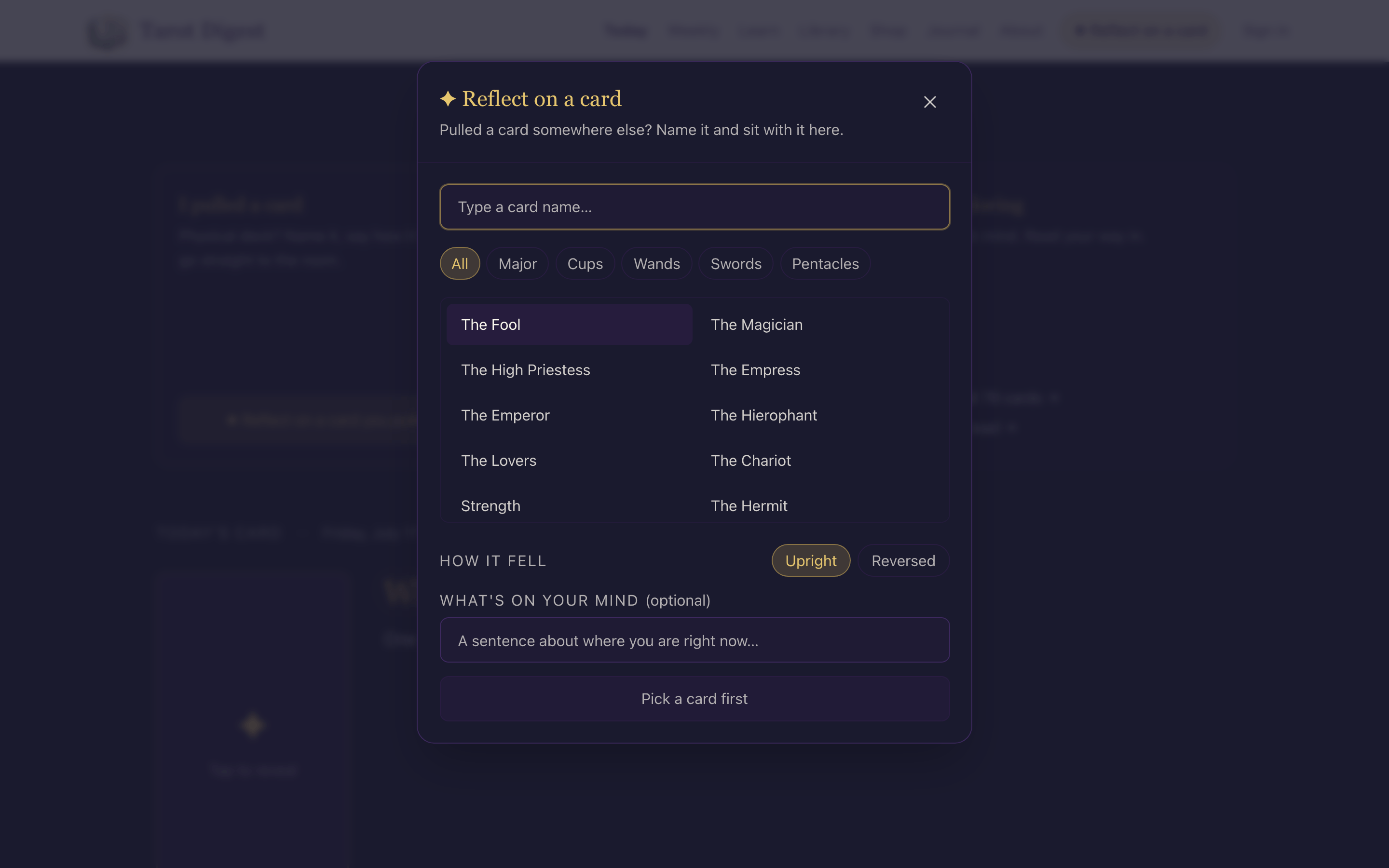
Pull a card however you like — a physical deck on the table, or a draw right here. Then name it. Type the card, add a line about what's on your mind if you want to, and that's the whole setup. No spread to memorise, no reversal rules to get right first.
Get questions, not predictions
The Reflection Room reads the card you brought and asks what it might be reflecting in your situation, then keeps the thread going as you think out loud. It never forecasts and never tells you what to do. Its whole job is to ask a better question than you'd have asked yourself.
More about the Reflection Room →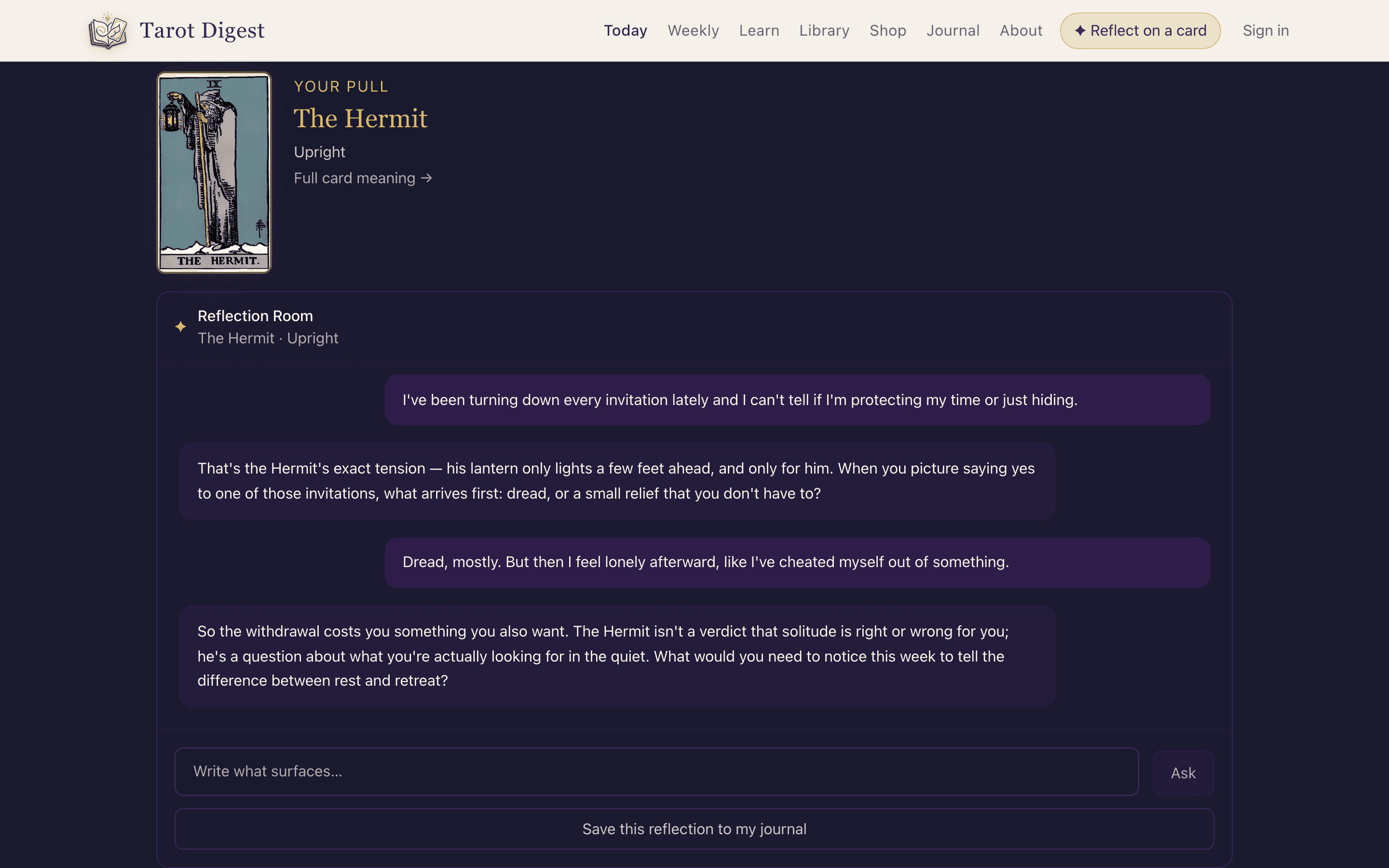
Save what's worth keeping
Keep the card, your notes, the whole conversation, or just one sentence. Your journal is a private record you can read back, export as a file, or delete whenever you want. Signed out, it lives on your device; with a free account, it syncs across your phone and laptop.
More about the Journal →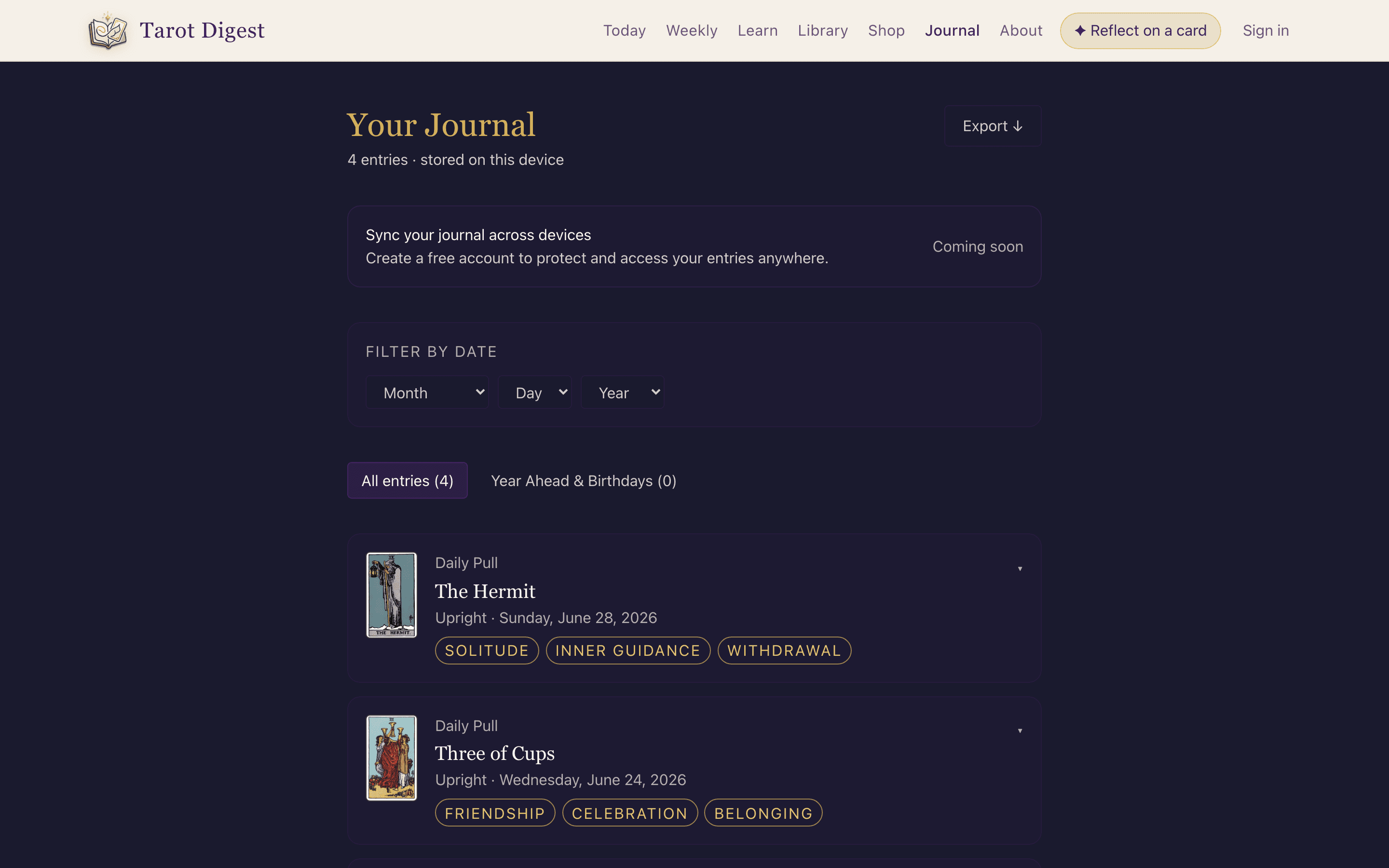
Come back and see the shape
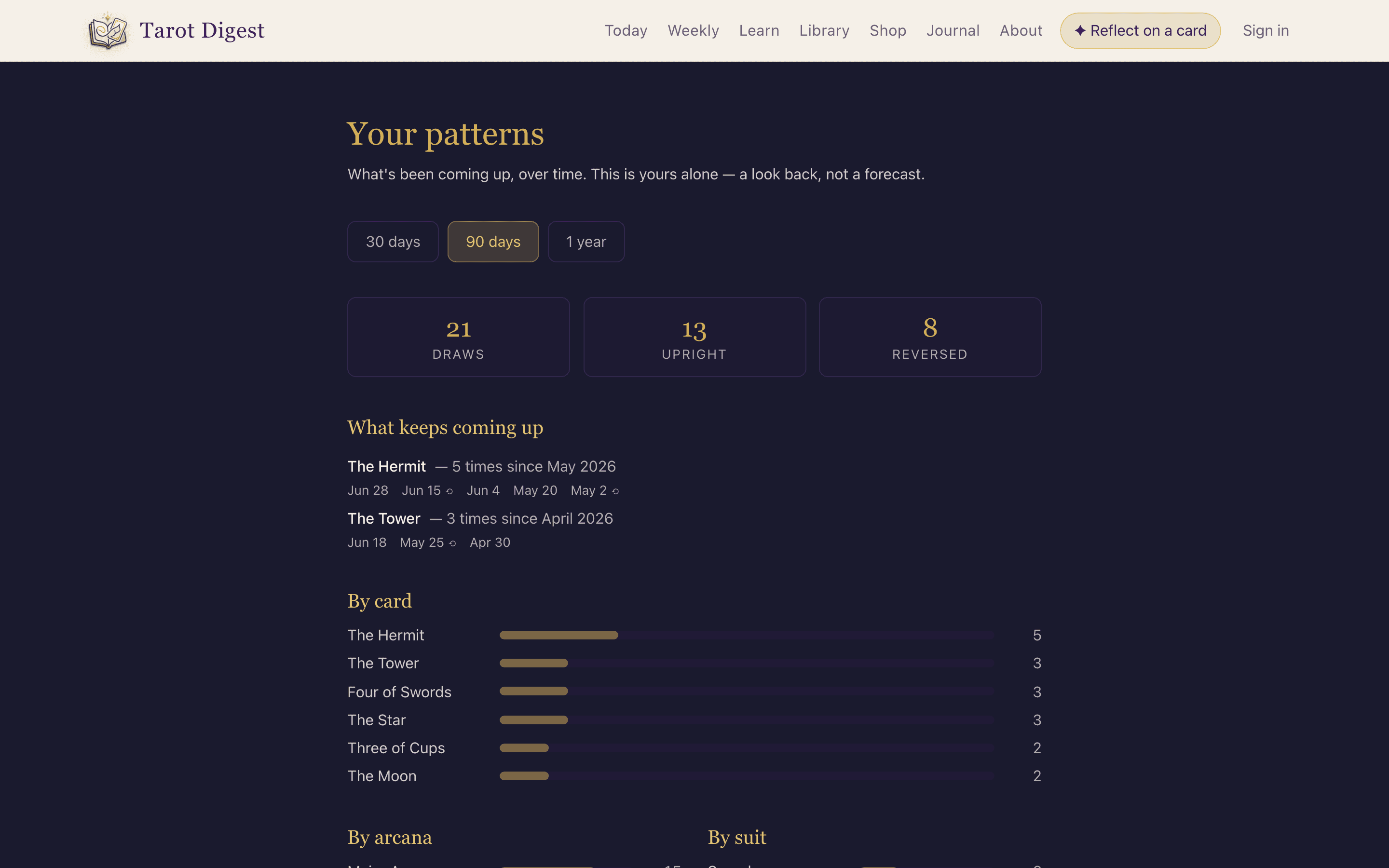
One entry is a note; a season of them is a picture. Return over weeks and months and the patterns view shows you which cards keep circling and what you wrote the last few times — the part a single reading can never give you.
Your journal is yours
We don't read it, we don't train AI on it, and we don't sell it. Your entries are fenced off so no other user can reach them, and you can export or delete everything yourself, anytime, without asking us. We won't claim we can't read your journal, because that would be a lie you couldn't check — we're telling you we don't, and the privacy policy says exactly what that means.
From the people using it
 Janet S.weekly reader
“I've been pulling a weekly tarot card for the last several years, and I often struggle with how to get started on my reflective practice... especially if the card isn't immediately relevant to my situation... tarotdigest.com's gentle and inquisitive prompts are amazing for helping me probe the more subtle nuances of the cards. Plus, the saved journal means I don't have to go scrolling back through my photo albums to see what I pulled the week before!”
 James J.daily practice
“Working with Tarotdigest.com over the last few weeks has really changed the way I think about the cards. Following the Fool's Journey really helps situate the cards in context. The AI prompts are really well trained and they genuinely feel helpful rather than typical AI slop.”
Questions a skeptic would ask
- Is this fortune-telling?
- No, and we'd rather lose you here than pretend otherwise. Nothing on this site predicts your future or tells you what to do. We treat the cards as mirrors, not maps: an image and a vocabulary for noticing what's already going on with you. If you want to know what happens next, this is the wrong tool.
- Do I have to believe in tarot?
- No. Plenty of people here think the whole thing is nonsense and still get something out of it. The mechanism is ordinary: a card gives you a specific, slightly strange prompt, and a specific prompt gets you further than a blank page. You can be a full skeptic and it still does the job.
- What does the AI actually see?
- When you ask for a reflection, the card and whatever you typed go to Anthropic's Claude to generate the questions. That's the whole payload. Anthropic doesn't train its models on it and deletes it within 30 days. We never send your words to analytics, and we never write them to a log.
- Can you read my journal?
- We don't, and nothing we build reads it for us. Your entries are fenced off in the database so no other user can reach them. Being straight with you: we don't encrypt them on your device, so we're not claiming we can't read them — we're telling you we don't. The privacy policy spells out exactly what that means.
- Do I need an account?
- No. The site works signed out, with your journal saved on your device. An account is free and does one thing: it syncs that journal across your devices and, over time, unlocks the patterns view. We ask for an email address and nothing else you don't offer.
- Is it free, and how do you make money?
- It's free, with no paywall on the core practice. A few links to decks and books are affiliate links, and there may be unobtrusive ads on public pages later — never on your journal or anything you write. That's the whole model.
- How is this different from plain journaling?
- Mostly it isn't, and that's the point. The card is a prompt generator and a way to notice repetition over time. If a blank notebook already works for you, keep using it. This is for people who find the blank page hard and a strange image easier to start from.
Try it on a card
Bring a card you've pulled and sit with it, or make a free account so your journal follows you between devices.