Three cards is the spread everyone starts with, and past/present/future is the reading everyone starts with. It's also the weakest thing you can do with three cards, because it turns a thinking tool into a prediction and then asks you to believe the prediction.
The positions are the spread. The cards are just images until you decide what each slot is asking. Choose the questions first and the same three cards will do considerably more work.
What the positions are actually for
A position is a question you commit to before you see the card. That order matters: decide what you're asking, then look. Reversing it, so that you see the card and then decide what it answers, is how you end up agreeing with yourself all afternoon.
Four sets of positions that pull their weight:
- Situation / obstacle / what I'm not looking at. The third slot is the useful one, and the one people quietly skip.
- What I want / what I'm doing / the gap. Good when you already know something is off but can't name it.
- The story I'm telling / what a friend would see / what I'd tell someone else. Useful when you've been rehearsing an argument in your head.
- What I'm holding / what I could put down / what that would cost. The third slot stops the second one from being glib.
Notice that none of these ask what happens next. That isn't squeamishness about prediction — it's that "what happens next" is the one question a picture of a person holding sticks cannot help you with, while "what am I not looking at" is a question it's surprisingly good at.
Reading across, not down
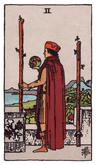
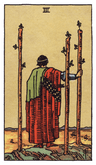
Most people read card one, then card two, then card three, and stop. The spread is the relationship between them. Two of Wands next to Three of Wands is a different reading from either card alone: one is standing at the map, the other is already at the harbour watching. Put them in obstacle and gap positions and the question writes itself — what changed between planning it and waiting for it?
If you can't say what the three cards have to do with each other, you have three one-card readings. That's fine, but it isn't a spread.
When a card doesn't fit
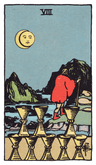
Sooner or later a card lands that has nothing to do with the position. The temptation is to stretch — to find some reading of Eight of Cups that makes it about your job after all. Don't. The friction is the information. A card that refuses to fit the slot you built for it is telling you the slot was wrong, which is a more interesting result than a card that agrees with you.
Sit with the mismatch for a minute before you re-draw. Most of the time you won't want to re-draw.
A worked example
Say the question is whether to leave a job. Positions: what I'm actually afraid of / what I'd be walking toward / what I'd have to admit.
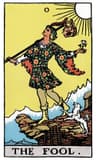
Draw The Fool in the first slot and the obvious reading — new beginnings! — is useless there. Read it as the fear and it sharpens immediately: you're afraid of looking naive. Of being the person who stepped off the cliff on purpose. That's a specific fear with a specific answer, and you got it because the position refused to let the card mean the easy thing.
How to close it
End with one sentence you could say out loud to another person. Not a summary of the cards — a sentence about your situation. If you can't produce one, the spread hasn't finished, and shuffling again won't help.