
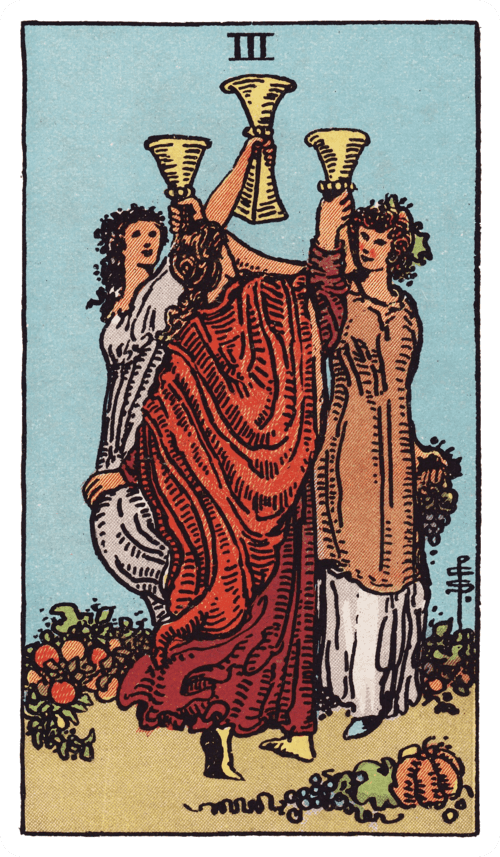
Cups · Minor Arcana
Three of Cups
Celebration, community, joy, shared abundance, friendship
Go deeper with Three of Cups
The meanings below are a starting point. Bring what's actually on your mind and reflect on it here — what comes back is a question to sit with, never a forecast.
Reflection Room
Three of Cups · upright
Write and save if you'd rather sit with it alone. Nothing is sent.
Three of Cups Upright Meaning
The Three of Cups is the energy of the first real harvest — three people gathered, cups raised, something genuine to celebrate. This card speaks to the particular joy of celebration with others: the shared laughter, the relief of being welcomed, the simple aliveness of genuine company. This might be literal gathering, or it might be the emotional experience of feeling genuinely seen and included in your communities.
This card as a mirror: where in your life right now is there genuine joy to celebrate — and with whom does it feel most alive to share it?
Three of Cups Reversed Meaning
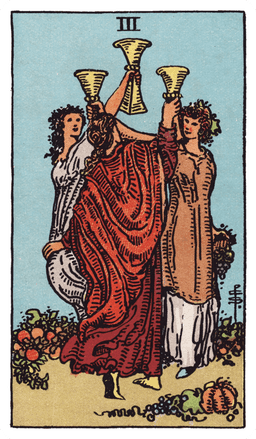
The Three of Cups reversed often suggests a painful distance from the celebration — whether you're excluded, isolated, or simply unable to feel the joy that should be there. Sometimes this card reversed points to people who gather, but without true connection. Other times it speaks to someone standing outside, watching others celebrate without being fully welcomed in.
This card as a mirror: where do you feel isolated right now — and is that isolation chosen, enforced, or the result of something unspoken?
The Three of Cups in Love & Relationships
Upright
This card asks you to notice where you feel genuinely welcomed and seen in your relationships. It's less about romance and more about the particular ease of being with someone — the laughter that comes without effort, the sense that you can be yourself without performing. What does it feel like to celebrate something real with the person or people in your life right now?
Reversed
When this card is reversed, it often points to a gap between what closeness looks like and what you're actually experiencing. You might be in a relationship that looks connected from the outside but feels hollow, or you might be aware of how much effort it takes to feel included. The question isn't whether the relationship is wrong — it's whether the distance you feel is something you can name and address, or whether it's settled into silence.
The Three of Cups in Work & Career
Upright
This card speaks to the particular satisfaction of doing good work alongside people who genuinely respect you. It's about teams that actually function, collaborations where ideas build, the difference between just working alongside someone and actually working together. Notice where your work life has this quality — and where it might be missing.
Reversed
Reversed, this card often shows up when you're working in isolation, or when you're in a group that doesn't feel like a real team. There's a difference between being left out and choosing to stay separate, and between a workplace that's cold and one where you've simply stopped trying to connect. What's actually happening in your work environment right now — and are you clear about it?
Three of Cups: Yes or No?
Leans toward yes — and the better question underneath is whether this thing you're asking about actually involves genuine connection with others, or whether you're looking for permission to join something that still feels distant.
Yes-or-no readings are the one place tarot pretends to be a fortune teller. We answer the question, then hand you the better one underneath it — that's the part worth your time.
Questions to ask when you draw Three of Cups
- What would it feel like to celebrate this with the specific people who matter to you?
- Where in your life right now do you feel like you belong without having to earn it?
- What's one thing you've been hesitant to share with others because you weren't sure they'd actually care?
Cards near Three of Cups
Next door in Cups
The other Threes
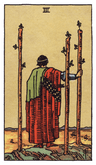
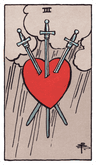
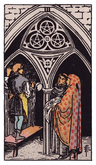
Shares its themes
Three of Cups Symbolism
Interpretive Traditions
Different schools of tarot bring different lenses to the Three of Cups. These are perspectives, not contradictions.
Rider-Waite-Smith
Waite emphasised the Three of Cups as friendship and merriment, but rooted in genuine regard. The harvest language is important — this is celebration because something real has been built and is now bearing fruit. It's not frivolity but earned joy.
Thoth
Crowley's Three of Cups is saturated with Venus in Cancer — sensual, nurturing community energy. It speaks to the pleasure of genuine gathering, not merely social obligation. The Thoth image emphasises the sensory aliveness of shared experience.
Modern Intuitive
Contemporary readers use this card to remind people that joy is medicine, that friendship is real work and real treasure, and that being gathered with your people is one of life's most sustaining experiences. If it's reversed, it becomes a clear signal to reach out, to risk connection.
Three of Cups Keywords & Themes
The Three of Cups tarot card is associated with the following themes and keywords across upright and reversed positions: celebration, friendship, community, abundance, joy, shared experience, isolation, exclusion, muted joy, disconnection from others, loneliness in a crowd. Its elemental correspondence is Water. Astrologically it is linked to Cancer. Its planetary ruler is Mercury.
Whether you drew the Three of Cups in a daily pull, a weekly spread, or a year-ahead reading, its core invitation is the same: to look honestly at what this card is reflecting in your own life. Tarot Digest uses the Three of Cups — and all 78 cards — as mirrors for self-inquiry, not prediction.
Recommended Decks & Books
Whether you're just starting with tarot or deepening a long practice, these are the decks and books most worth your time.
- 🃏
The Original Rider Waite Smith Tarot — A.E. Waite & Pamela Coleman Smith
The deck that defined modern tarot. First published in 1909, the RWS introduced illustrated pip cards for all 78 positions — a breakthrough that made tarot accessible to everyone. Every major deck since is either an homage or a reaction to it.
- 📖
Seventy-Eight Degrees of Wisdom — Rachel Pollack
The definitive companion to tarot, first published in 1980 and still the best single-volume guide. Pollack reads the cards as a living psychological system — the Major Arcana as a map of consciousness, the Minor as the terrain of daily life.
- 📖
The Creative Tarot — Jessa Crispin
A guide to using tarot as a tool for creative practice rather than divination — written for writers, artists, and makers. Crispin brings a sharp literary sensibility and treats the cards as a language for thinking about creative process.
- 🃏
Modern Witch Tarot Deck — Lisa Sterle
The RWS structure reimagined with diverse, contemporary figures in modern settings. Every symbol from the original is preserved (the Fool still stands at the cliff edge, the High Priestess still flanked by pillars), but the world looks like ours.
Links above may earn a small commission at no cost to you — affiliate code tarotdigest-20. Disclosure