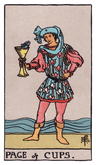
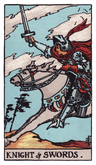
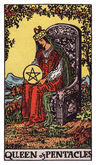
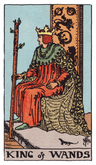
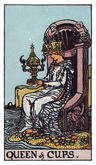
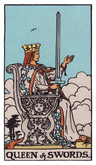
Ask a room of tarot readers which cards they find hardest and most of them will say the court cards. There are sixteen of them, they all look like royalty standing around, and the usual advice, that each one represents a person in your life, turns every reading into a guessing game about who the Queen of Swords is supposed to be. There's a better default, and it makes the whole court easier: read them as parts of yourself first, and other people only when the reading insists.
Two dials: which suit, which mode
Every court card is a combination of two simple things. The suit tells you the domain, the same four you already know: Wands for drive and action, Cups for feeling and connection, Swords for thought and truth, Pentacles for the material and the practical. The rank tells you the mode you're in within that domain. Once you read a court card as suit-plus-mode rather than as a mystery person, it stops being a wall.
The four modes, plainly:
- Pages are the beginner's mode: curious, unguarded, willing to look foolish. The energy of just starting.
- Knights are the mode of pursuit: committed, fast, sometimes reckless. All forward motion, not much reflection.
- Queens are the mode of mastery held inward: they embody the suit and understand it from the inside.
- Kings are the mode of mastery turned outward: they direct the suit, take responsibility for it, use it in the world.
Suit is the subject. Rank is how you're holding it. A court card is rarely a stranger; it's usually a description of how you're currently doing one particular thing.
The same suit through all four modes
Take Cups, the suit of feeling. The Page of Cups is a new feeling you haven't named yet, tender and slightly awkward. The Queen of Cups is someone who feels deeply and isn't swept away by it, who can hold their own emotion and yours without drowning. Same domain, different relationship to it. When one of them shows up, the question isn't "who is this," it's "is this how I'm handling feeling right now, and is it serving me?"
Contrast that with a Swords court like the Knight of Swords, who charges at a problem with an argument already loaded. Read as a part of you, it asks whether your speed and certainty are cutting through something or just cutting. That's a far more useful question than trying to work out which colleague it represents.
When it really is a person
Sometimes a court card does point at someone. You usually know because the reading is already about a relationship, and the card's qualities land on a specific face without you forcing it. The Queen of Pentacles can absolutely be the steady, practical person who's been holding things together, if that person is what the question is about. The rule of thumb: try it on yourself first, and only hand it to someone else when your own reflection comes up genuinely empty.
Even then, the person the card describes is usually less important than the mode they represent. The King of Wands as your ambitious friend is a footnote; the King of Wands as the decisive, take-charge energy the situation is calling for, or the domineering one it's suffering from, is the reading.
When a court card is reversed
A reversed court card usually means the mode is blocked, overdone, or turned against itself, rather than flipped to its opposite. A reversed Knight is the pursuit stalled, or the recklessness left running with none of the courage underneath it. A reversed Queen can be the suit's mastery pulled too far inward, self-possession tipping into shut-off. Read the reversal as the same mode under strain, the way you would any reversed card, and ask where that strain is showing up in how you're handling the suit's domain. The question stays the same; the pressure on it is what changed.
A quick way to place any court card
When one turns up and you're stuck, ask two questions in order. What is this card about (name the suit's domain), and how is it being held (name the rank's mode). Wands plus Knight: pursuing a goal, fast, maybe too fast. Pentacles plus Page: a beginner's curiosity about money, work, or the body. You can construct a workable reading of any of the sixteen from those two answers alone, and refine it from there.