
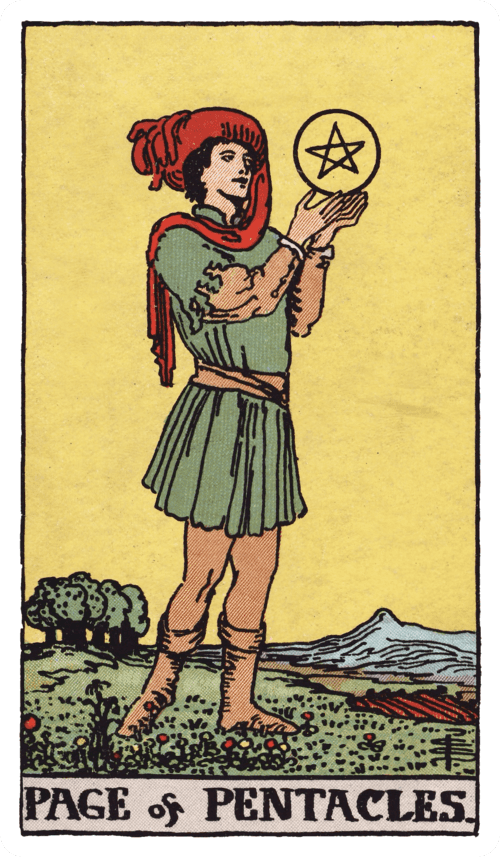
Pentacles · Minor Arcana
Page of Pentacles
Beginning to learn, practical curiosity, a new skill or project, student energy
Also known as
Thoth: Princess of Pentacles — In Thoth, the Princess of Pentacles is a diligent student of the material world — same learning, patient energy as the Page. 'Princess of Pentacles' = this card.
Historical / pre-Waite: Knave of Pentacles — The pre-Waite term for the fourth court card.
Go deeper with Page of Pentacles
The meanings below are a starting point. Bring what's actually on your mind and reflect on it here — what comes back is a question to sit with, never a forecast.
Reflection Room
Page of Pentacles · upright
Write and save if you'd rather sit with it alone. Nothing is sent.
Page of Pentacles Upright Meaning
The Page of Pentacles is the beginner — someone who has just encountered a practical domain and is learning its language with genuine curiosity and focus. This might be a literal student (in school, in a job training, in a new role), or it might be an aspect of yourself that is new to something: a new hobby, a new project, a new area of work. The Page brings a kind of humble attention — not yet expert, but genuinely interested in understanding how things work. This card often appears when you're embarking on a learning curve or when a message or opportunity related to practical development is arriving. It can also represent a person in your life who brings this energy.
This card invites you to ask: what are you genuinely curious about learning — and are you giving yourself permission to be a beginner at it?
Page of Pentacles Reversed Meaning
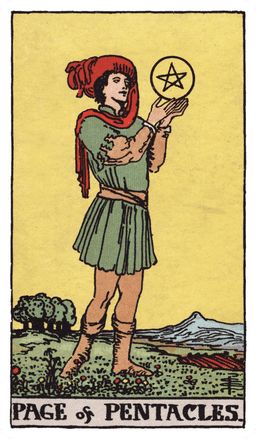
The Page reversed can signal that learning has stalled — you've lost interest or moved on before really understanding the fundamentals. It might point to scattered curiosity that jumps from one thing to another without deepening. It can also suggest that someone who should be open to learning is being stubborn or resistant, or that a message or opportunity isn't being received because you're not in a receptive frame of mind. Sometimes this card reversed signals that you're trying to skip the beginner phase and move to advanced work without building the foundation.
This card asks: what are you not wanting to learn, or what have you started but are avoiding the actual foundational work?
The Page of Pentacles in Love & Relationships
Upright
This card suggests you're in a phase of learning your partner, or learning yourself in relation to them — whether that's early dating, a shift in the relationship, or a new understanding of what you both need. The Page's attention here is earnest and undefended: you're paying attention without pretense. What's worth noticing is whether you're actually absorbing what you're learning, or just collecting information.
Reversed
You might be avoiding the real work of understanding — staying on the surface, jumping between people or partners without settling into the harder job of knowing someone, or resisting what a partner is trying to show you about themselves or the relationship. Sometimes this signals that you've stopped being curious about someone you thought you knew, or that you're expecting to skip the patient, unglamorous phase of building trust.
The Page of Pentacles in Work & Career
Upright
You're either new to something in your work or entering a period where you need to genuinely learn rather than rely on what you already know. The Page here is humble and focused — able to ask questions without ego. What matters is noticing whether this curiosity is active or whether you're just occupying a beginner's role without actually engaging with the material.
Reversed
You might be resisting the foundational work: impatient to advance, dismissing the basics as beneath you, or moving on from projects before you understand how they actually work. Alternatively, you've lost interest in something you started and are coasting, or someone offering you knowledge or a chance to develop your skills isn't getting through because you're not genuinely open to it.
Page of Pentacles: Yes or No?
Leans toward yes — and the better question underneath is: are you willing to do the unglamorous work of actually learning this, or are you looking for a shortcut?
Yes-or-no readings are the one place tarot pretends to be a fortune teller. We answer the question, then hand you the better one underneath it — that's the part worth your time.
Questions to ask when you draw Page of Pentacles
- What are you genuinely curious about right now that you've been putting off as impractical or not worth the time?
- Where in your life are you pretending to understand something when you actually don't, and what would happen if you admitted you were a beginner?
- What did you start learning that you abandoned before it got interesting, and what would it take to come back to it?
Cards near Page of Pentacles
Next door in Pentacles
The other Pages
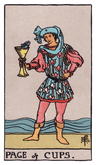
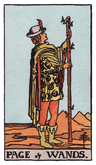
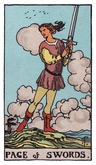
Shares its themes
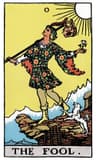
Page of Pentacles Symbolism
Interpretive Traditions
Different schools of tarot bring different lenses to the Page of Pentacles. These are perspectives, not contradictions.
Rider-Waite-Smith
Waite saw the Page as the beginning of mastery — the student who is engaged and eager. He emphasised that this is a card of genuine promise if the openness continues.
Thoth
In Crowley's system, the Page represents the beginning of manifestation in practical matters — a message, an opportunity, or the awakening of practical awareness.
Modern Intuitive
Contemporary readers often interpret this as permission to be a beginner and to value the learning process rather than rushing to expertise. It can represent a person or an aspect of yourself.
Page of Pentacles Keywords & Themes
The Page of Pentacles tarot card is associated with the following themes and keywords across upright and reversed positions: learning, beginner, curiosity, new skill, fresh start, blocked learning, resistance, scattered curiosity, avoidance, lack of focus. Its elemental correspondence is Earth. Astrologically it is linked to Taurus.
Whether you drew the Page of Pentacles in a daily pull, a weekly spread, or a year-ahead reading, its core invitation is the same: to look honestly at what this card is reflecting in your own life. Tarot Digest uses the Page of Pentacles — and all 78 cards — as mirrors for self-inquiry, not prediction.
Recommended Decks & Books
Whether you're just starting with tarot or deepening a long practice, these are the decks and books most worth your time.
- 🃏
The Original Rider Waite Smith Tarot — A.E. Waite & Pamela Coleman Smith
The deck that defined modern tarot. First published in 1909, the RWS introduced illustrated pip cards for all 78 positions — a breakthrough that made tarot accessible to everyone. Every major deck since is either an homage or a reaction to it.
- 📖
Seventy-Eight Degrees of Wisdom — Rachel Pollack
The definitive companion to tarot, first published in 1980 and still the best single-volume guide. Pollack reads the cards as a living psychological system — the Major Arcana as a map of consciousness, the Minor as the terrain of daily life.
- 📖
The Creative Tarot — Jessa Crispin
A guide to using tarot as a tool for creative practice rather than divination — written for writers, artists, and makers. Crispin brings a sharp literary sensibility and treats the cards as a language for thinking about creative process.
- 🃏
Modern Witch Tarot Deck — Lisa Sterle
The RWS structure reimagined with diverse, contemporary figures in modern settings. Every symbol from the original is preserved (the Fool still stands at the cliff edge, the High Priestess still flanked by pillars), but the world looks like ours.
Links above may earn a small commission at no cost to you — affiliate code tarotdigest-20. Disclosure